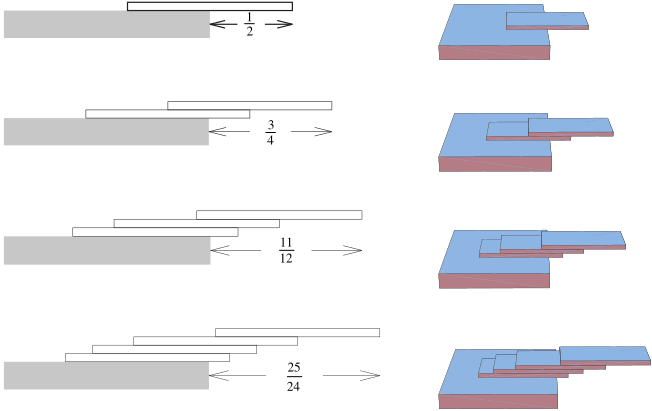
The book stacking problem asks how far a balanced stack of identical books of uniform density can protrude over the edge
of a table. In the idealized planar model, the books are horizontal rigid blocks
and contact forces are vertical. With one book per level and a positive integer, the
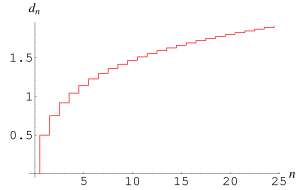
maximum possible overhang (in terms of book lengths) is half the th partial sum of the harmonic
series (Paterson and Zwick 2009, p. 19).
The balancing condition is that the vertical projection of the center of mass of the books above each interface lie over the supporting region at that
interface. In the harmonic arrangement attaining this bound, the projection lies
exactly above the right edge of each supporting book. Since the books are identical,
placing the top
books in equilibrium adds of a book length to the overhang, which gives the harmonic
sum below.
When considering the stacking of a deck of 52 cards so that maximum overhang occurs, the total amount of overhang achieved after sliding over 51 cards leaving the bottom one fixed, measured from the edge of the bottom card, is
(6)
(7)
(8)
(Derbyshire 2004, p. 6).
For ,
the number of books required with one book per level is the smallest positive
integer
satisfying .
For ,
2, ... book-lengths of overhang, 4, 31, 227, 1674, 12367, 91380, 675214, 4989191,
36865412, 272400600, ... (OEIS A014537) books
are needed.
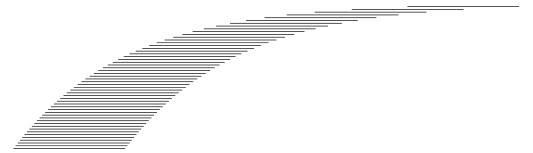
When more than one book or card can be used per level, greater overhangs are possible and the problem becomes much more complex. For example, Paterson and Zwick (2009, p. 43) report an oil-lamp construction with an overhang of 10 using 921 blocks with additional point weights.


 identical books of uniform density can protrude over the edge
of a table. In the idealized planar model, the books are horizontal rigid blocks
and contact forces are vertical. With one book per level and
 a positive integer, the
maximum possible overhang
 (in terms of book lengths) is half the
 th partial sum of the harmonic
series (Paterson and Zwick 2009, p. 19).
 books in equilibrium adds
 of a book length to the overhang, which gives the harmonic
sum below.

 is a harmonic number. The first few values are


 are given by OEIS A001008 and OEIS A002805,
respectively.


 ,
the number of books required with one book per level is the smallest positive
integer
 satisfying
 .
For
 ,
2, ... book-lengths of overhang, 4, 31, 227, 1674, 12367, 91380, 675214, 4989191,
36865412, 272400600, ... (OEIS A014537) books
are needed.
