

Bicubic interpolation is a two-dimensional interpolation method obtained from cubic interpolation in each coordinate. On a rectangular cell, the interpolant has the form
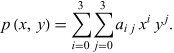 |
Its 16 coefficients can be determined from function values and first partial and mixed derivatives
at the four corners. In image processing, bicubic convolution instead forms the interpolated
value from a  neighborhood of samples using a piecewise cubic convolution kernel (Keys 1981). Bicubic
interpolation is generally smoother than interpolation using a polynomial that is
linear in each coordinate, but it can overshoot the range of the sampled values.
neighborhood of samples using a piecewise cubic convolution kernel (Keys 1981). Bicubic
interpolation is generally smoother than interpolation using a polynomial that is
linear in each coordinate, but it can overshoot the range of the sampled values.
