

Bertrand's problem asks for the probability that a chord drawn at random on a circle
of radius  (i.e., circle line picking)
has length
(i.e., circle line picking)
has length  (or sometimes greater than or equal to the side length of an inscribed equilateral
triangle; Solomon 1978, p. 2). The answer depends on the interpretation of "two
points drawn at random," or more specifically on the "natural" measure
for the problem.
(or sometimes greater than or equal to the side length of an inscribed equilateral
triangle; Solomon 1978, p. 2). The answer depends on the interpretation of "two
points drawn at random," or more specifically on the "natural" measure
for the problem.
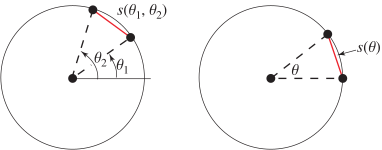
In the most commonly considered measure, the angles  and
and  are picked at random on the circumference
of the circle. Without loss of generality, this can be formulated as the probability
that the chord length of a single point at random angle
are picked at random on the circumference
of the circle. Without loss of generality, this can be formulated as the probability
that the chord length of a single point at random angle  measured from the intersection of the
positive x-axis along the unit circle. Since the
length as a function of
measured from the intersection of the
positive x-axis along the unit circle. Since the
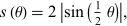
length as a function of  (circle line picking)
is given by
(circle line picking)
is given by
 |
(1)
|
solving for  gives
gives  ,
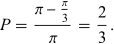
so the fraction of the top unit semicircle having chord length greater than 1 is
,
so the fraction of the top unit semicircle having chord length greater than 1 is
 |
(2)
|
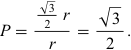
However, if a point is instead placed at random on a radius of the circle and a chord drawn perpendicular to it, then
 |
(3)
|
The latter interpretation is more satisfactory in the sense that the result remains the same for a rotated circle, a slightly smaller circle inscribed in the first, or for a circle of the same size but with its center slightly offset. Jaynes (1983) shows that the interpretation of "random" as a continuous uniform distribution over the radius is the only one possessing all these three invariances.
