

A Behrend sequence is a strictly increasing sequence  of integers greater than 1 for which
the set
 of positive multiples of members
of
 has natural density 1 (Hall and Tenenbaum 1992).
Equivalently, almost every positive integer has
a divisor in
 . By the Davenport-Erdős
theorem, the definition is equivalent to requiring logarithmic
density 1 for
 (Davenport and Erdős 1936).
Let  denote the lower natural density of a set
 . Behrend's inequality in its lower-density form is
 |
Here  and
 are sets of integers greater than 1 (Behrend 1948, Hall and Tenenbaum 1992). If
 is Behrend, at least one of
 and
 is Behrend. A nonempty finite set of integers greater than
1 cannot be Behrend, since integers congruent to 1 modulo the least
common multiple of its members avoid all their multiples. Thus deleting finitely
many terms leaves a Behrend sequence. More generally, for every fixed positive
integer
 , almost every integer has at least
 distinct divisors in
 (Hall and Tenenbaum 1992). Ruzsa and Tenenbaum (1996) showed
that every Behrend sequence can be partitioned into countably infinitely many Behrend
subsequences.
The sum  must diverge. If the terms of
 are pairwise relatively prime,
this condition is also sufficient. For arbitrary terms the converse fails. For example,
the reciprocals of the positive even integers have
a divergent sum, and their set of multiples has natural
density
 .
Ruzsa and Tenenbaum (1996) gave a criterion for an arbitrary set  of semiprimes, including possible
squares of primes. For each prime
number
 , let
 , and
for
 let
 .
Both sums run over primes
 , and the first may be infinite.
The set
 is Behrend if and only if
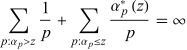 |
for every  , with both sums over primes
 . For the special case of the products of primes
 ,
 with
 and
 , Erdős (1959) showed that the required
condition is
 .
A less immediate example of a Behrend sequence is the set of distinct products  of positive
integers with
 , arranged in increasing
order (Hall and Tenenbaum 1992). Whenever such a product divides
 , both
 and
 divide
 . Thus almost all integers have
a pair of divisors with ratio at most 2.
Hall and Tenenbaum (1992) also considered the set of products  with
 .
It is Behrend for
 and fails to be Behrend for
 . Their result leaves
equality open. This asks for a product
 dividing
 , with the interval width governed
by
 . In the close-divisor problem discussed under the Erdős-Hooley delta function, the
divisors are only required to divide
 individually, and the interval width is governed by
 .
