

A Bayesian model specifies a sampling distribution  for observed data
  together with a prior distribution
  for the unknown parameter
  . Bayes' theorem gives
the posterior distribution
. Bayes' theorem gives
the posterior distribution
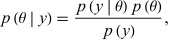 |
where  is the marginal likelihood. Bayesian model comparison uses these marginal likelihoods
or approximations such as the Bayesian
information criterion.
is the marginal likelihood. Bayesian model comparison uses these marginal likelihoods
or approximations such as the Bayesian
information criterion.
