


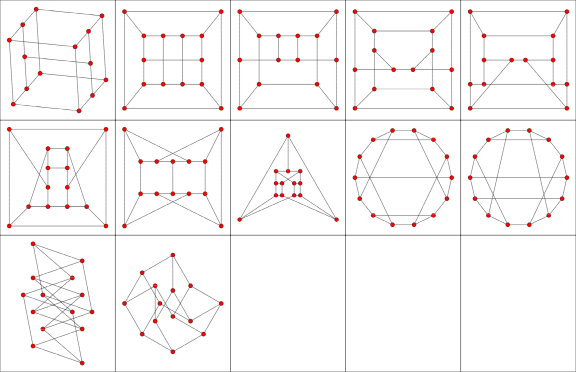
The antibox graph is the 14-vertex, 21-edge cubic Hamiltonian graph illustrated above. It has girth 4, graph crossing number 2, graph diameter 4, and chromatic number 3. It is also an apex graph.
Robertson et al. (2019) do not explain the prefix "anti-". The name appears to refer to the box-like visual appearance of the graph in the drawing presented in their Fig. 9 and to identify it as a counterpart of the box graph.
The antibox graph was defined as an intermediate obstruction in a characterization of highly connected cubic graphs by forbidden topological minors (Robertson et al. 2019). It occurs together with the drape graph, Petersen graph, triplex graph, and box graph in the proof.
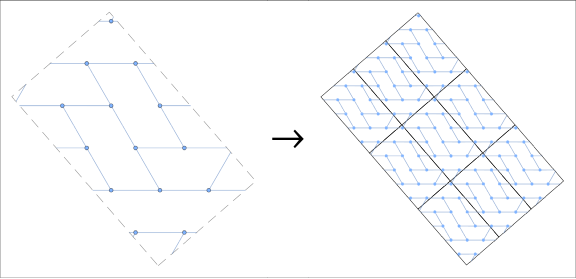
The antibox graph is a toroidal graph, as illustrated above. The left-hand drawing shows an embedding in a fundamental region whose paired boundary sides are identified to form a torus. The right-hand drawing shows a finite patch of the corresponding periodic lift, illustrating how edges continue across these boundaries and where corresponding vertices in different regions represent the same vertex on the torus.
The antibox graph is implemented in the Wolfram Language as GraphData["AntiboxGraph"].
