

An alternating descent of a permutation  is an index
 for which
 when
 is odd, or
 when
 is even (Chebikin 2008). The alternating Eulerian polynomial
is
 |
(1)
|
It has positive, palindromic coefficients, with 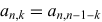 and
 .
The first three are 1,
 ,
and
 . Unlike ordinary Eulerian
polynomials, their zeros lie on the unit circle
(Ma and Yeh 2016).
Wang and Zheng (2026) proved that  is a logarithmically
concave sequence for every
 ,
settling a conjecture of Lin et al. (2022). Their proof combines a factorization
into reciprocal quadratic factors with exact integer verifications for finitely many
cases. The same log-concavity holds for the distribution of 3-descents in
 , where a 3-descent is a consecutive triple having
relative order 132, 213, or 321; its generating polynomial is
 .
The maximum coefficient occurs at  .
For
 , Wang and Zheng (2026) give
 |
(2)
|
and
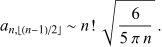 |
(3)
|
More generally, the normalized coefficients satisfy a uniform local normal approximation, centered at  with asymptotic variance
 . The homogeneous
polynomial
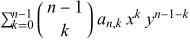 is Lorentzian and
completely log-concave.
