

The Akiyama-Tanigawa algorithm is a triangular recurrence for computing Bernoulli numbers and transforming sequences (Kaneko 2000, Akiyama and Tanigawa 2001). Starting with
 |
(1)
|
define subsequent rows by
 |
(2)
|
for nonnegative integers  and
 .
The leading element of row
 is
 |
(3)
|
where  is a Bernoulli polynomial and
 uses the convention
 . Thus the algorithm gives
 and agrees with
 at every other index (Kaneko 2000, Chen 2001).
More generally, an arbitrary initial row  gives
 |
(4)
|
where  is a Stirling number of the second
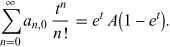
kind. If the initial row has ordinary generating
function
 , then the leading column
has exponential generating function
 |
(5)
|
These identities hold as formal power series (Kaneko 2000).
Chen's (2001) variation uses the same initial row and the recurrence
 |
(6)
|
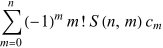
Its leading column satisfies
 |  |  |
(7)
|
 |  |  |
(8)
|
In particular,  gives the conventional Bernoulli
numbers
 . The choice
 gives the Euler polynomial
values
 under the original recurrence and
 under the variation. The choice
 gives the Bell numbers
with indices
 and
 ,
respectively (Chen 2001).
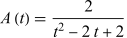
The initial row with ordinary generating function
 |
(9)
|
gives the signed Euler numbers  under the original recurrence. Under the variation, the
leading column has exponential generating
function
 . Writing its entries as
 , the initial value is
 and
 |  |  |
(10)
|
 |  |  |
(11)
|
for  , where
 is a tangent number in
the positive convention
 ,
 ,
 ,
... (Chen 2001).
A two-parameter generalization replaces the recurrence by
 |
(12)
|
For nonzero  and
 , its leading-column exponential
generating function is
 |
(13)
|
(Rahmani 2013).
