The 18-point problem asks whether points can be placed sequentially on a line segment so that, after the th placement, the points occupy distinct th subintervals of the segment. Formally, for a given , does there exist a sequence of real
numbers ,
, ..., such that for every and every , the inequality
holds for some ?
Surprisingly, it is only possible to place 17 points in this manner (Berlekamp and
Graham 1970, Warmus 1976).
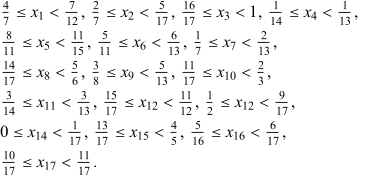
Steinhaus (1979) gives a 14-point solution (0.06, 0.55, 0.77, 0.39, 0.96, 0.28, 0.64, 0.13, 0.88, 0.48, 0.19, 0.71, 0.35, 0.82), and Warmus (1976) gives the 17-point solution
Warmus (1976) states that there are 768 patterns of 17-point solutions (counting reversals as equivalent).
Berlekamp, E. R. and Graham, R. L. "Irregularities in the Distributions of Finite Sequences." J. Number Th.2, 152-161,
1970.Gardner, M. The
Last Recreations: Hydras, Eggs, and Other Mathematical Mystifications. New
York: Springer-Verlag, pp. 34-36, 1997.Steinhaus, H. "Distribution
on Numbers" and "Generalization." Problems 6 and 7 in One
Hundred Problems in Elementary Mathematics. New York: Dover, pp. 12-13,
1979.Warmus, M. "A Supplementary Note on the Irregularities of
Distributions." J. Number Th.8, 260-263, 1976.


 th placement, the
  points occupy distinct
  th subintervals of the segment. Formally, for a given
  , does there exist a sequence of real
numbers
, does there exist a sequence of real
numbers  ,
,
 , ...,
  such that for every
 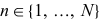 and every
  , the inequality
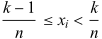
 ?
Surprisingly, it is only possible to place 17 points in this manner (Berlekamp and
Graham 1970, Warmus 1976).
?
Surprisingly, it is only possible to place 17 points in this manner (Berlekamp and
Graham 1970, Warmus 1976).