


A square root of  is a number
  such that
  .
When written in the form
.
When written in the form  or especially
  ,
the square root of
,
the square root of  may also be called the radical or surd.
The square root is therefore an nth root with
may also be called the radical or surd.
The square root is therefore an nth root with
 .
.
Note that any positive real number has two square roots, one positive and one negative. For example, the square roots of 9 are  and
and  ,
since
,
since  .
Any nonnegative real number
.
Any nonnegative real number  has a unique nonnegative square root
  ; this is called the principal
square root and is written
; this is called the principal
square root and is written  or
or  . For example, the principal
square root of 9 is
. For example, the principal
square root of 9 is  ,
while the other square root of 9 is
,
while the other square root of 9 is  . In common usage, unless otherwise specified, "the"
square root is generally taken to mean the principal square root. The principal square
root function
. In common usage, unless otherwise specified, "the"
square root is generally taken to mean the principal square root. The principal square
root function  is the inverse function of
  for
for  .
.


Any nonzero complex number  also has two square roots. For example, using the imaginary
unit i, the two square roots of
also has two square roots. For example, using the imaginary
unit i, the two square roots of  are
are 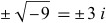 . The principal
square root of a number
. The principal
square root of a number  is denoted
  (as in the positive real case) and is returned by the
Wolfram Language function Sqrt[z].
(as in the positive real case) and is returned by the
Wolfram Language function Sqrt[z].
When considering a positive real number  , the Wolfram Language
function Surd[x,
2] may be used to return the real square root.
, the Wolfram Language
function Surd[x,
2] may be used to return the real square root.
The square roots of a complex number  are given by
![sqrt(x+iy)=+/-(x^2+y^2)^(1/4){cos[1/2tan^(-1)(x,y)]+isin[1/2tan^(-1)(x,y)]}.](/images/equations/SquareRoot/NumberedEquation1.svg) |
(1)
|
In addition,
![sqrt(x+iy)=1/2sqrt(2)[sqrt(sqrt(x^2+y^2)+x)+isgn(y)sqrt(sqrt(x^2+y^2)-x)].](/images/equations/SquareRoot/NumberedEquation2.svg) |
(2)
|
As can be seen in the above figure, the imaginary part of the complex square root function has a branch cut along the negative real axis.
There are a number of square root algorithms that can be used to approximate the square root of a given (positive real) number.
These include the Bhaskara-Brouncker algorithm and Wolfram's
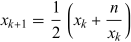
iteration. The simplest algorithm for  is Newton's iteration:
 |
(3)
|
with  .
.
The square root of 2 is the irrational number  (OEIS A002193)
sometimes known as Pythagoras's constant,
which has the simple periodic continued fraction
[1, 2, 2, 2, 2, 2, ...] (OEIS A040000). The
square root of 3 is the irrational number
(OEIS A002193)
sometimes known as Pythagoras's constant,
which has the simple periodic continued fraction
[1, 2, 2, 2, 2, 2, ...] (OEIS A040000). The
square root of 3 is the irrational number  (OEIS A002194),
sometimes known as Theodorus's constant, which
has the simple periodic continued fraction
[1, 1, 2, 1, 2, 1, 2, ...] (OEIS A040001).
In general, the continued fractions of the
square roots of all positive integers are periodic.
(OEIS A002194),
sometimes known as Theodorus's constant, which
has the simple periodic continued fraction
[1, 1, 2, 1, 2, 1, 2, ...] (OEIS A040001).
In general, the continued fractions of the
square roots of all positive integers are periodic.
A nested radical of the form  can sometimes be simplified into a simple square root by equating
 |
(4)
|
Squaring gives
 |
(5)
|
so
 |  |  |
(6)
|
 |  |  |
(7)
|
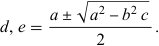
Solving for  and
and  gives
gives
 |
(8)
|
For example,
 |
(9)
|
 |
(10)
|
The Simplify command of the Wolfram Language does not apply such simplifications, but FullSimplify does. In general, radical denesting is a difficult problem (Landau 1992ab, 1994, 1998).
A counterintuitive property of inverse functions is that
![sqrt(z)sqrt(1/z)={-1 for Im[z]=0 and Re[z]<0; undefined for z=0; 1 otherwise,](/images/equations/SquareRoot/NumberedEquation9.svg) |
(11)
|
so the expected identity (i.e., canceling of the  s) does not hold along the negative real axis.

 : Four Different Views." Math. Intell. 20,
55-60, 1998.Sloane, N. J. A. Sequences
: Four Different Views." Math. Intell. 20,
55-60, 1998.Sloane, N. J. A. Sequences  and Its Reciprocal," "The
  Function and Its Reciprocal," and "The
 Function." Chs. 12,
14, and 15 in
Function." Chs. 12,
14, and 15 in  ." Math. Comput. 36, 593-601, 1981.