


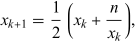
Newton's iteration is an algorithm for computing the square root  of a number
  via the recurrence equation
 |
(1)
|
where  .
This recurrence converges quadratically as
.
This recurrence converges quadratically as  .
.
Newton's iteration is simply an application of Newton's method for solving the equation
 |
(2)
|
For example, when applied numerically, the first few iterations to Pythagoras's constant  are 1, 1.5, 1.41667, 1.41422, 1.41421, ....
The first few approximants  ,
,  , ... to
  are given by
 |
(3)
|
These can be given by the analytic formula
 |  | ![sqrt(n)[1+2/(((1+sqrt(n))/(1-sqrt(n)))^(2^k)-1)]](/images/equations/NewtonsIteration/Inline11.svg) |
(4)
|
 |  |  |
(5)
|
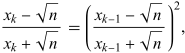
These can be derived by noting that the recurrence can be written as
 |
(6)
|
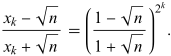
which has the clever closed-form solution
 |
(7)
|
Solving for  then gives the solution derived above.
The following table summarizes the first few convergents for small positive integer 

 ,
,  , ...
, ...