


The Shrikhande graph is a strongly regular graph on 16 nodes. It is cospectral
with the rook graph  , so neither of the two is determined
by spectrum.
, so neither of the two is determined
by spectrum.
The Shrikhande graph is the smallest distance-regular graph that is not distance-transitive
(Brouwer et al. 1989, p. 136). It has intersection
array  .
.
The Shrikhande graph (denoted  by Egawa 1981) can be constructed on a set
of vertices
by Egawa 1981) can be constructed on a set
of vertices  with
with  with edges between
two vertices
with edges between
two vertices  and
and  iff
iff  ,
,  , and
, and  (mod 4) (Egawa 1981).

The Shrikhande graph has two generalized LCF notations of order 8, eleven of order 4, 53 of order 2, and 2900 of order 1. The graphs with LCF notations of orders four and eight are illustrated above.
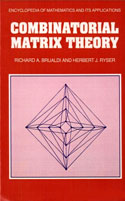
The Shrikhande graph appears on the cover of the book Combinatorial Matrix Theory by Brualdi and Ryser (1991), illustrated above.

The plots above show the adjacency matrix, incidence matrix, and graph distance matrices for the Shrikhande graph.
It is an integral graph with graph spectrum  .
.
The bipartite double graph of the Shrikhande graph is the Kummer graph.
The Doob graph  is the graph given by the graph Cartesian product of
  copies of the Shrikhande graph with a Hamming
graph
copies of the Shrikhande graph with a Hamming
graph  .
The Egawa graph
.
The Egawa graph  is constructed as the graph Cartesian product
of
is constructed as the graph Cartesian product
of  copies of the Shrikhande graph and
  copies of a Hamming graph
(Egawa 1981).
copies of a Hamming graph
(Egawa 1981).

The Shrikhande graph has graph genus 1 and its graph complement has graph genus 5 (E. Weisstein, Jan. 13, 2026). It is therefore a toroidal graph, as illustrated above.
The Shrikhande graph is implemented in the Wolfram Language as GraphData["ShrikhandeGraph"].

 by the Parameters." J. Combin. Th., Ser. A 31,
108-125, 1981.House of Graphs. "Shrikhande Graph."
by the Parameters." J. Combin. Th., Ser. A 31,
108-125, 1981.House of Graphs. "Shrikhande Graph."  Association Scheme." Ann. Math. Stat. 30,
781-798, 1959.van Dam, E. R. and Haemers, W. H. "Which
Graphs Are Determined by Their Spectrum?" Lin. Algebra Appl. 373,
139-162, 2003.
Association Scheme." Ann. Math. Stat. 30,
781-798, 1959.van Dam, E. R. and Haemers, W. H. "Which
Graphs Are Determined by Their Spectrum?" Lin. Algebra Appl. 373,
139-162, 2003.