


A run is a sequence of more than one consecutive identical outcomes, also known as a clump.
Let  be the probability that a run
of
be the probability that a run
of  or more consecutive heads appears
in
or more consecutive heads appears
in  independent tosses of a coin
(i.e.,
independent tosses of a coin
(i.e.,  Bernoulli
trials). This is equivalent to repeated picking from an urn containing two distinguishable
objects with replacement after each pick. Let the probability of obtaining a head
be
Bernoulli
trials). This is equivalent to repeated picking from an urn containing two distinguishable
objects with replacement after each pick. Let the probability of obtaining a head
be  . Then there is a beautiful
formula for
. Then there is a beautiful
formula for  given in terms of the coefficients
of the generating function
given in terms of the coefficients
of the generating function
 |
(1)
|
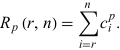
(Feller 1968, p. 300). Then
 |
(2)
|
The following table gives the triangle of numbers  for
for  , 2, ... and
  , 2, ...,
  (OEIS A050227).
| Sloane | A000225 | A008466 | A050231 | A050233 | ||||
 | 1 | 2 | 3 | 4 | 5 | 6 | 7 | 8 |
| 1 | 1 | 0 | 0 | 0 | 0 | 0 | 0 | 0 |
| 2 | 3 | 1 | 0 | 0 | 0 | 0 | 0 | 0 |
| 3 | 7 | 3 | 1 | 0 | 0 | 0 | 0 | 0 |
| 4 | 15 | 8 | 3 | 1 | 0 | 0 | 0 | 0 |
| 5 | 31 | 19 | 8 | 3 | 1 | 0 | 0 | 0 |
| 6 | 63 | 43 | 20 | 8 | 3 | 1 | 0 | 0 |
| 7 | 127 | 94 | 47 | 20 | 8 | 3 | 1 | 0 |
| 8 | 255 | 201 | 107 | 48 | 20 | 8 | 3 | 1 |
The special case  gives the sequence
 |
(3)
|
where  is a Fibonacci
number. Similarly, the probability that no
is a Fibonacci
number. Similarly, the probability that no  consecutive tails will occur in
  tosses is given by
  , where
  is a Fibonacci
k-step number.
is a Fibonacci
k-step number.
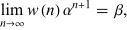
Feller (1968, pp. 278-279) proved that for  ,
,
 |
(4)
|
where
 |  |  |
(5)
|
 |  |  |
(6)
|
(OEIS A086253) is the positive root of the above polynomial and
 |  |  |
(7)
|
 |  |  |
(8)
|
 |  |  |
(9)
|
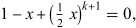
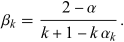
(OEIS A086254) is the positive root of the above polynomial. The corresponding constants for a run of  heads are
  , the smallest positive root of
 |
(10)
|
and
 |
(11)
|
These are modified for unfair coins with  and
and  to
to  , the smallest positive root of
 |
(12)
|
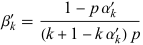
and
 |
(13)
|
(Feller 1968, pp. 322-325).
Given  Bernoulli
trials with a probability of success (heads)
Bernoulli
trials with a probability of success (heads)  , the expected number of tails is
  , so the expected number of tail runs
  is
is  .
Continuing,
.
Continuing,
 |
(14)
|
is the expected number of runs  .
The longest expected run is therefore given by
.
The longest expected run is therefore given by
![R=log_(1/p)[n(1-p)]](/images/equations/Run/NumberedEquation10.svg) |
(15)
|
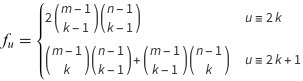
(Gordon et al. 1986, Schilling 1990). Given  0s and
  1s, the number of possible arrangements with
  runs is
 |
(16)
|
for  an integer,
where
an integer,
where  is a binomial
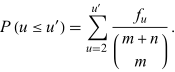
coefficient (Johnson and Kotz 1968, p. 268). Then
is a binomial
coefficient (Johnson and Kotz 1968, p. 268). Then
 |
(17)
|
Now instead consider picking of  objects without replacement from a collection of
  containing
  indistinguishable objects of one type and
  indistinguishable objects of another. Let
  denote the number of permutations of these objects
in which no
denote the number of permutations of these objects
in which no  -run
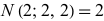
occurs. For example, there are 6 permutations of two objects of type
-run
occurs. For example, there are 6 permutations of two objects of type  and two of type
  . Of these,
  ,
,
 ,
,  , and
, and  contain runs of length two, so
  .
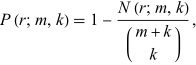
In general, the probability that an
.
In general, the probability that an  -run does occur is given by
 |
(18)
|
where  is a binomial
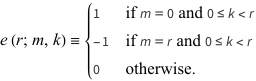
coefficient. Bloom (1996) gives the following recurrence sequence for
is a binomial
coefficient. Bloom (1996) gives the following recurrence sequence for  ,
,
 |
(19)
|
where  for
for  or
or  negative and
 |
(20)
|
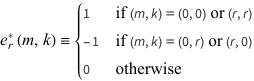
Another recurrence which has only a fixed number of terms is given by
 |
(21)
|
where
 |
(22)
|
(Goulden and Jackson 1983, Bloom 1996).
These formulas can be used to calculate the probability of obtaining a run of  cards of the same color in a deck of
52 cards. For
cards of the same color in a deck of
52 cards. For  ,
2, ..., this yields the sequence 1, 247959266474051/247959266474052, ... (OEIS A086439 and A086440).
Normalizing by multiplying by
,
2, ..., this yields the sequence 1, 247959266474051/247959266474052, ... (OEIS A086439 and A086440).
Normalizing by multiplying by  gives 495918532948104, 495918532948102, 495891608417946, 483007233529142, ... (OEIS
A086438). The result
gives 495918532948104, 495918532948102, 495891608417946, 483007233529142, ... (OEIS
A086438). The result
 |
(23)
|
disproves the assertion of Gardner (1982) that "there will almost always be a clump of six or seven cards of the same color" in a normal deck of cards.
Bloom (1996) gives the expected number of noncontiguous  -runs (i.e., split the sequence into maximal clumps of the
same value and count the number of such clumps of length
-runs (i.e., split the sequence into maximal clumps of the
same value and count the number of such clumps of length  ) in a sequence of
  0s and
  1s as
1s as
 |
(24)
|
where  is the falling
factorial. For
is the falling
factorial. For  ,
,
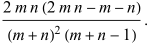
 has an approximately normal
distribution with mean and variance
has an approximately normal
distribution with mean and variance
 |  |  |
(25)
|
 |  |  |
(26)
|

 ."
Commun. Stat.: Th. and Meth. 19, 1291-1301, 1990.Godbole,
A. P. and Papastavridis, G. (Eds.).
."
Commun. Stat.: Th. and Meth. 19, 1291-1301, 1990.Godbole,
A. P. and Papastavridis, G. (Eds.).