


For a single variate  having a distribution
  with known population
mean
with known population
mean  ,
the population variance
,
the population variance  ,
commonly also written
,
commonly also written  ,
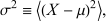
is defined as
,
is defined as
 |
(1)
|
where  is the population
mean and
is the population
mean and  denotes the expectation value of
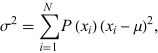
  . For a discrete distribution
with
. For a discrete distribution
with  possible values of
  , the population variance is therefore
 |
(2)
|
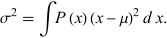
whereas for a continuous distribution, it is given by
 |
(3)
|
The variance is therefore equal to the second central moment  .
.
Note that some care is needed in interpreting  as a variance, since the symbol
  is also commonly used as a parameter related to but not
equivalent to the square root of the variance, for example in the log
normal distribution, Maxwell distribution,
and Rayleigh distribution.
is also commonly used as a parameter related to but not
equivalent to the square root of the variance, for example in the log
normal distribution, Maxwell distribution,
and Rayleigh distribution.
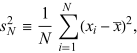
If the underlying distribution is not known, then the sample variance may be computed as
 |
(4)
|
where  is the sample
mean.
is the sample
mean.
Note that the sample variance  defined above is not an unbiased
estimator for the population variance
defined above is not an unbiased
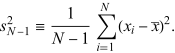
estimator for the population variance  . In order to obtain an unbiased estimator for
  , it is necessary to instead define a "bias-corrected
sample variance"
, it is necessary to instead define a "bias-corrected
sample variance"
 |
(5)
|
The distinction between  and
and  is a common source of confusion,
and extreme care should be exercised when consulting the literature to determine
which convention is in use, especially since the uninformative notation
is a common source of confusion,
and extreme care should be exercised when consulting the literature to determine
which convention is in use, especially since the uninformative notation  is commonly used for both. The bias-corrected sample variance
 for a list of data is implemented
as Variance[list].
for a list of data is implemented
as Variance[list].
The square root of the variance is known as the standard deviation.
The reason that  gives a biased estimator of the population variance
is that two free parameters
gives a biased estimator of the population variance
is that two free parameters  and
and  are actually being estimated from
the data itself. In such cases, it is appropriate to use a Student's t-distribution
instead of a normal distribution as a model
since, very loosely speaking, Student's t-distribution
is the "best" that can be done without knowing
are actually being estimated from
the data itself. In such cases, it is appropriate to use a Student's t-distribution
instead of a normal distribution as a model
since, very loosely speaking, Student's t-distribution
is the "best" that can be done without knowing  .
.
Formally, in order to estimate the population variance  from a sample of
  elements with a priori unknown mean
(i.e., the mean is estimated from the sample itself), we
need an unbiased estimator for
elements with a priori unknown mean
(i.e., the mean is estimated from the sample itself), we
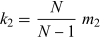
need an unbiased estimator for  . This is given by the k-statistic
  , where
 |
(6)
|
and  is the sample
variance uncorrected for bias.
is the sample
variance uncorrected for bias.
It turns out that the quantity  has a chi-squared
distribution.
has a chi-squared
distribution.
For set of data  ,
the variance of the data obtained by a linear transformation is given by
,
the variance of the data obtained by a linear transformation is given by
 |  | ![<[(aX+b)-<aX+b>]^2>](/images/equations/Variance/Inline35.svg) |
(7)
|
 |  |  |
(8)
|
 |  |  |
(9)
|
 |  |  |
(10)
|
 |  |  |
(11)
|
 |  |  |
(12)
|
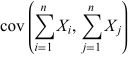
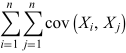
For multiple variables, the variance is given using the definition of covariance,
 |  |  |
(13)
|
 |  |  |
(14)
|
 |  | 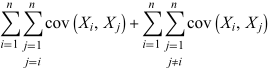 |
(15)
|
 |  | 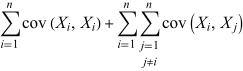 |
(16)
|
 |  | 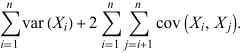 |
(17)
|
A linear sum has a similar form:
 |  | 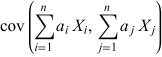 |
(18)
|
 |  | 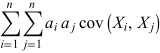 |
(19)
|
 |  |  |
(20)
|
These equations can be expressed using the covariance matrix.
