

The differential equation describing exponential growth is
 |
(1)
|
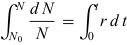
This can be integrated directly
 |
(2)
|
to give
 |
(3)
|
where 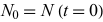 .
Exponentiating,
.
Exponentiating,
 |
(4)
|
This equation is called the law of growth and, in a much more antiquated fashion, the Malthusian
equation; the quantity  in this equation is sometimes known as the Malthusian
parameter.
in this equation is sometimes known as the Malthusian
parameter.
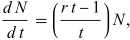
Consider a more complicated growth law
 |
(5)
|
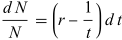
where  is a constant. This can also be integrated directly
 |
(6)
|
 |
(7)
|
 |
(8)
|
Note that this expression blows up at  . We are given the initial
condition that
. We are given the initial
condition that  ,
so
,
so  .
.
 |
(9)
|
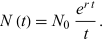
The  in the denominator of (9) greatly
suppresses the growth in the long run compared to the simple growth law.
in the denominator of (9) greatly
suppresses the growth in the long run compared to the simple growth law.
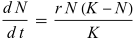
The (continuous) logistic equation, defined by
 |
(10)
|
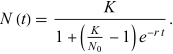
is another growth law which frequently arises in biology. It has solution
 |
(11)
|
