


The logistic equation (sometimes called the Verhulst model or logistic growth curve) is a model of population growth first published by Pierre Verhulst (1845, 1847). The model is continuous in time, but a modification of the continuous equation to a discrete quadratic recurrence equation known as the logistic map is also widely used.

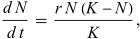
The continuous version of the logistic model is described by the differential equation
 |
(1)
|
where  is the Malthusian parameter (rate of maximum
population growth) and
is the Malthusian parameter (rate of maximum
population growth) and  is the so-called carrying capacity (i.e., the maximum sustainable
population). Dividing both sides by
is the so-called carrying capacity (i.e., the maximum sustainable
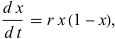
population). Dividing both sides by  and defining
  then gives the differential equation
 |
(2)
|
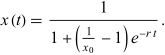
which is known as the logistic equation and has solution
 |
(3)
|
The function  is sometimes known as the sigmoid function.
While  is usually constrained to be positive, plots of the above solution are shown for
various positive and negative values of
is usually constrained to be positive, plots of the above solution are shown for
various positive and negative values of  and initial conditions
  ranging from 0.00 to 1.00 in steps of 0.05.
The discrete version of the logistic equation (3) is known as the logistic map.
The curve
 |
(4)
|
obtained from (3) is sometimes known as the logistic curve. Similarly, a normalized form of equation (3) is commonly used as a statistical distribution known as the logistic distribution.
