


A periodic continued fraction is a continued fraction (generally a regular continued fraction) whose terms eventually repeat from some point onwards. The minimal number of repeating terms is called the period of the continued fraction. All nontrivial periodic continued fractions represent irrational numbers. In general, an infinite simple fraction (periodic or otherwise) represents a unique irrational number, and each irrational number has a unique infinite continued fraction.
The square root of a squarefree integer has a periodic continued fraction of the form
![sqrt(n)=[a_0;a_1,a_2,a_3,...,a_2,a_1,2a_0^_]](/images/equations/PeriodicContinuedFraction/NumberedEquation1.svg) |
(1)
|
(Rose 1994, p. 130), where the repeating portion (excluding the last term) is symmetric upon reversal, and the central term may appear either once or twice.
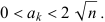
If  is not a square number, then the terms of the continued
fraction of
is not a square number, then the terms of the continued
fraction of  satisfy
 |
(2)
|
An even stronger result is that a continued fraction is periodic iff it is a root of a quadratic
polynomial. Calling the portion of a number  remaining after a given convergent the "tail," it
must be true that the relationship between the number
remaining after a given convergent the "tail," it
must be true that the relationship between the number  and terms in its tail is of the
form
and terms in its tail is of the
form
 |
(3)
|
which can only lead to a quadratic equation.

The periods of the continued fractions of the square roots of the first few nonsquare integers 2, 3, 5, 6, 7, 8, 10, 11, 12, 13, ... (OEIS A000037) are 1, 2, 1, 2, 4, 2, 1, 2, 2, 5, ... (OEIS A013943; Williams 1981, Jacobson et al. 1995). These numbers and their continued fraction representations are summarized in the following table.
 |  |  |  |
| 2 | ![[1,2^_]](/images/equations/PeriodicContinuedFraction/Inline9.svg) | 22 | ![[4,1,2,4,2,1,8^_]](/images/equations/PeriodicContinuedFraction/Inline10.svg) |
| 3 | ![[1,1,2^_]](/images/equations/PeriodicContinuedFraction/Inline11.svg) | 23 | ![[4,1,3,1,8^_]](/images/equations/PeriodicContinuedFraction/Inline12.svg) |
| 5 | ![[2,4^_]](/images/equations/PeriodicContinuedFraction/Inline13.svg) | 24 | ![[4,1,8^_]](/images/equations/PeriodicContinuedFraction/Inline14.svg) |
| 6 | ![[2,2,4^_]](/images/equations/PeriodicContinuedFraction/Inline15.svg) | 26 | ![[5,10^_]](/images/equations/PeriodicContinuedFraction/Inline16.svg) |
| 7 | ![[2,1,1,1,4^_]](/images/equations/PeriodicContinuedFraction/Inline17.svg) | 27 | ![[5,5,10^_]](/images/equations/PeriodicContinuedFraction/Inline18.svg) |
| 8 | ![[2,1,4^_]](/images/equations/PeriodicContinuedFraction/Inline19.svg) | 28 | ![[5,3,2,3,10^_]](/images/equations/PeriodicContinuedFraction/Inline20.svg) |
| 10 | ![[3,6^_]](/images/equations/PeriodicContinuedFraction/Inline21.svg) | 29 | ![[5,2,1,1,2,10^_]](/images/equations/PeriodicContinuedFraction/Inline22.svg) |
| 11 | ![[3,3,6^_]](/images/equations/PeriodicContinuedFraction/Inline23.svg) | 30 | ![[5,2,10^_]](/images/equations/PeriodicContinuedFraction/Inline24.svg) |
| 12 | ![[3,2,6^_]](/images/equations/PeriodicContinuedFraction/Inline25.svg) | 31 | ![[5,1,1,3,5,3,1,1,10^_]](/images/equations/PeriodicContinuedFraction/Inline26.svg) |
| 13 | ![[3,1,1,1,1,6^_]](/images/equations/PeriodicContinuedFraction/Inline27.svg) | 32 | ![[5,1,1,1,10^_]](/images/equations/PeriodicContinuedFraction/Inline28.svg) |
| 14 | ![[3,1,2,1,6^_]](/images/equations/PeriodicContinuedFraction/Inline29.svg) | 33 | ![[5,1,2,1,10^_]](/images/equations/PeriodicContinuedFraction/Inline30.svg) |
| 15 | ![[3,1,6^_]](/images/equations/PeriodicContinuedFraction/Inline31.svg) | 34 | ![[5,1,4,1,10^_]](/images/equations/PeriodicContinuedFraction/Inline32.svg) |
| 17 | ![[4,8^_]](/images/equations/PeriodicContinuedFraction/Inline33.svg) | 35 | ![[5,1,10^_]](/images/equations/PeriodicContinuedFraction/Inline34.svg) |
| 18 | ![[4,4,8^_]](/images/equations/PeriodicContinuedFraction/Inline35.svg) | 37 | ![[6,12^_]](/images/equations/PeriodicContinuedFraction/Inline36.svg) |
| 19 | ![[4,2,1,3,1,2,8^_]](/images/equations/PeriodicContinuedFraction/Inline37.svg) | 38 | ![[6,6,12^_]](/images/equations/PeriodicContinuedFraction/Inline38.svg) |
| 20 | ![[4,2,8^_]](/images/equations/PeriodicContinuedFraction/Inline39.svg) | 39 | ![[6,4,12^_]](/images/equations/PeriodicContinuedFraction/Inline40.svg) |
| 21 | ![[4,1,1,2,1,1,8^_]](/images/equations/PeriodicContinuedFraction/Inline41.svg) | 40 | ![[6,3,12^_]](/images/equations/PeriodicContinuedFraction/Inline42.svg) |
An upper bound for the length of the period is roughly  . The least positive
  s such that the continued fraction of
  has period
  , 2, ... are 2, 3, 41, 7, 13, 19, 58, 31, 106, ... (OEIS
A013646). The first few values of
, 2, ... are 2, 3, 41, 7, 13, 19, 58, 31, 106, ... (OEIS
A013646). The first few values of  such that the continued fraction of
  has period
  are summarized below for small
  .
.
 | OEIS |  |
| 1 | A002522 | 2, 5, 10, 17, 26, 37, 50, 65, 82, 101, ... |
| 2 | A013642 | 3, 6, 8, 11, 12, 15, 18, 20, 24, 27, ... |
| 3 | A013643 | 41, 130, 269, 370, 458, ... |
| 4 | A013644 | 7, 14, 23, 28, 32, 33, 34, 47, 55, 60, ... |
| 5 | A010337 | 13, 29, 53, 74, 85, 89, 125, 173, 185, 218, ... |
| 6 | A020347 | 19, 21, 22, 45, 52, 54, 57, 59, 70, 77, ... |
| 7 | A010338 | 58, 73, 202, 250, 274, 314, 349, 425, ... |
| 8 | A020348 | 31, 44, 69, 71, 91, 92, 108, 135, 153, 158, ... |
| 9 | A010339 | 106, 113, 137, 149, 265, 389, 493, ... |
| 10 | A020349 | 43, 67, 86, 93, 115, 116, 118, 129, 154, 159, ... |
The values of  at which the period of the continued fraction of
  increases are 1, 2, 3, 7, 13, 19, 31, 43, 46, 94, 139,
151, 166, 211, 331, 421, 526, 571, ... (OEIS A013645).
increases are 1, 2, 3, 7, 13, 19, 31, 43, 46, 94, 139,
151, 166, 211, 331, 421, 526, 571, ... (OEIS A013645).
General identities for periodic continued fractions include
![[a^_]](/images/equations/PeriodicContinuedFraction/Inline55.svg) |  |  |
(4)
|
![[1,a^_]](/images/equations/PeriodicContinuedFraction/Inline58.svg) |  | 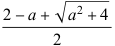 |
(5)
|
![[a,2a^_]](/images/equations/PeriodicContinuedFraction/Inline61.svg) |  |  |
(6)
|
![[a,b^_]](/images/equations/PeriodicContinuedFraction/Inline64.svg) |  | 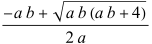 |
(7)
|
![[a_1,...,a_n^_]](/images/equations/PeriodicContinuedFraction/Inline67.svg) |  |  |
(8)
|
![[a_0,b_1,...,b_n^_]](/images/equations/PeriodicContinuedFraction/Inline70.svg) |  | ![a_0+1/([b_1,...,b_n^_])](/images/equations/PeriodicContinuedFraction/Inline72.svg) |
(9)
|
![[b_1,...,b_n^_]](/images/equations/PeriodicContinuedFraction/Inline73.svg) |  | ![([b_1,...,b_n^_]p_n+p_(n-1))/([b_1,...,b_n^_]q_n+q_(n-1))](/images/equations/PeriodicContinuedFraction/Inline75.svg) |
(10)
|
(Wall 1948, pp. 39 and 83).
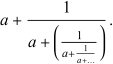
The first follows from
 |  |  |
(11)
|
 |  |  |
(12)
|
Therefore,
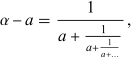 |
(13)
|
so plugging (13) into (12) gives
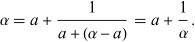 |
(14)
|
Expanding
 |
(15)
|
and solving using the quadratic formula gives
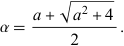 |
(16)
|
The analog of this treatment in the general case gives
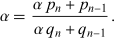 |
(17)
|
