TOPICS
Search

Quadratic Formula


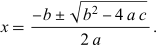
The quadratic formula gives the roots of a quadratic equation

 ax^2+bx+c=0
(1)

with a!=0 as

 x=(-b+/-sqrt(b^2-4ac))/(2a).
(2)

An alternate form, valid when the denominator is nonzero, is given by
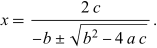
 x=(2c)/(-b+/-sqrt(b^2-4ac)).
(3)

For a quadratic equation with leading coefficient 1,

 x^2+px+q=0,
(4)

the quadratic formula becomes the pq formula (Kucherenko 2007),

 x=-p/2+/-sqrt((p^2)/4-q).
(5)

This form follows by dividing the general quadratic equation by a and setting p=b/a and q=c/a. For real p and q, the roots are real iff p^2-4q>=0.


See also

Completing the Square, Quadratic, Quadratic Equation Explore this topic in the MathWorld classroom

Explore with Wolfram|Alpha

References

Kucherenko, T. "Inequalities." UCLA Math Circle, 2007. https://web.archive.org/web/20210924000500id_/https://circles.math.ucla.edu/circles/lib/data/handoutId15-0.pdf.

Referenced on Wolfram|Alpha

Quadratic Formula

Cite this as:

Weisstein, Eric W. "Quadratic Formula." From MathWorld--A Wolfram Resource. https://mathworld.wolfram.com/QuadraticFormula.html

Subject classifications