


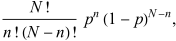
The binomial distribution gives the discrete probability distribution  of obtaining exactly
  successes out of
  Bernoulli trials (where
the result of each Bernoulli trial is true with
probability
Bernoulli trials (where
the result of each Bernoulli trial is true with
probability  and false with probability
  ). The binomial distribution is therefore given by
 |  |  |
(1)
|
 |  |  |
(2)
|
where  is a binomial coefficient. The above plot
shows the distribution of
is a binomial coefficient. The above plot
shows the distribution of  successes out of
  trials with
  .
.
The binomial distribution is implemented in the Wolfram Language as BinomialDistribution[n, p].
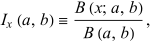
The probability of obtaining more successes than the  observed in a binomial distribution is
 |
(3)
|
where
 |
(4)
|
 is the beta function, and
  is the incomplete
beta function.
is the incomplete
beta function.
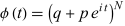
The characteristic function for the binomial distribution is
 |
(5)
|
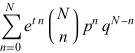
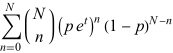
(Papoulis 1984, p. 154). The moment-generating function  for the distribution is
 |  |  |
(6)
|
 |  |  |
(7)
|
 |  |  |
(8)
|
 |  | ![[pe^t+(1-p)]^N](/images/equations/BinomialDistribution/Inline31.svg) |
(9)
|
 |  | ![N[pe^t+(1-p)]^(N-1)(pe^t)](/images/equations/BinomialDistribution/Inline34.svg) |
(10)
|
 |  | ![N(N-1)[pe^t+(1-p)]^(N-2)(pe^t)^2+N[pe^t+(1-p)]^(N-1)(pe^t).](/images/equations/BinomialDistribution/Inline37.svg) |
(11)
|
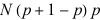
The mean is
 |  |  |
(12)
|
 |  |  |
(13)
|
 |  |  |
(14)
|
The moments about 0 are
 |  |  |
(15)
|
 |  |  |
(16)
|
 |  |  |
(17)
|
 |  |  |
(18)
|
so the moments about the mean are
 |  |  |
(19)
|
 |  |  |
(20)
|
 |  | ![Np(1-p)[3p^2(2-N)+3p(N-2)+1].](/images/equations/BinomialDistribution/Inline67.svg) |
(21)
|
The skewness and kurtosis excess are
 |  |  |
(22)
|
 |  |  |
(23)
|
 |  |  |
(24)
|
 |  |  |
(25)
|
The first cumulant is
 |
(26)
|
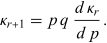
and subsequent cumulants are given by the recurrence relation
 |
(27)
|
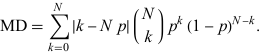
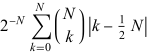
The mean deviation is given by
 |
(28)
|
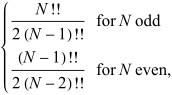
For the special case  , this is equal to
 |  |  |
(29)
|
 |  |  |
(30)
|
where  is a double factorial. For
  , 2, ..., the first few values are therefore 1/2, 1/2, 3/4,
3/4, 15/16, 15/16, ... (OEIS A086116 and A086117). The general case is given by
, 2, ..., the first few values are therefore 1/2, 1/2, 3/4,
3/4, 15/16, 15/16, ... (OEIS A086116 and A086117). The general case is given by
 |
(31)
|
Steinhaus (1999, pp. 25-28) considers the expected number of squares  containing a given number of grains
  on board of size
  after random distribution of
  of grains,
 |
(32)
|
Taking  gives the results summarized in the following table.
 |  |
| 0 | 23.3591 |
| 1 | 23.7299 |
| 2 | 11.8650 |
| 3 | 3.89221 |
| 4 | 0.942162 |
| 5 | 0.179459 |
| 6 | 0.0280109 |
| 7 | 0.0036840 |
| 8 |  |
| 9 |  |
| 10 |  |
An approximation to the binomial distribution for large  can be obtained by expanding about the value
  where
where  is a maximum, i.e., where
  . Since the logarithm function
is monotonic, we can instead choose to expand
the logarithm. Let
. Since the logarithm function
is monotonic, we can instead choose to expand
the logarithm. Let  , then
![ln[P(n)]=ln[P(n^~)]+B_1eta+1/2B_2eta^2+1/(3!)B_3eta^3+...,](/images/equations/BinomialDistribution/NumberedEquation9.svg) |
(33)
|
where
![B_k=[(d^kln[P(n)])/(dn^k)]_(n=n^~).](/images/equations/BinomialDistribution/NumberedEquation10.svg) |
(34)
|
But we are expanding about the maximum, so, by definition,
![B_1=[(dln[P(n)])/(dn)]_(n=n^~)=0.](/images/equations/BinomialDistribution/NumberedEquation11.svg) |
(35)
|
This also means that  is negative, so we can write
  . Now, taking the logarithm
of (2) gives
. Now, taking the logarithm
of (2) gives
![ln[P(n)]=lnN!-lnn!-ln(N-n)!+nlnp+(N-n)lnq.](/images/equations/BinomialDistribution/NumberedEquation12.svg) |
(36)
|
For large  and
and  we can use Stirling's approximation
 |
(37)
|
so
![(d[ln(n!)])/(dn)](/images/equations/BinomialDistribution/Inline108.svg) |  |  |
(38)
|
 |  |  |
(39)
|
![(d[ln(N-n)!])/(dn)](/images/equations/BinomialDistribution/Inline114.svg) |  | ![d/(dn)[(N-n)ln(N-n)-(N-n)]](/images/equations/BinomialDistribution/Inline116.svg) |
(40)
|
 |  | ![[-ln(N-n)+(N-n)(-1)/(N-n)+1]](/images/equations/BinomialDistribution/Inline119.svg) |
(41)
|
 |  |  |
(42)
|
and
![(dln[P(n)])/(dn) approx -lnn+ln(N-n)+lnp-lnq.](/images/equations/BinomialDistribution/NumberedEquation14.svg) |
(43)
|
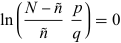
To find  ,
set this expression to 0 and solve for
,
set this expression to 0 and solve for  ,
,
 |
(44)
|
 |
(45)
|
 |
(46)
|
 |
(47)
|
since  .
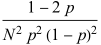
We can now find the terms in the expansion
.
We can now find the terms in the expansion
 |  | ![[(d^2ln[P(n)])/(dn^2)]_(n=n^~)](/images/equations/BinomialDistribution/Inline128.svg) |
(48)
|
 |  |  |
(49)
|
 |  |  |
(50)
|
 |  |  |
(51)
|
 |  | ![[(d^3ln[P(n)])/(dn^3)]_(n=n^~)](/images/equations/BinomialDistribution/Inline140.svg) |
(52)
|
 |  |  |
(53)
|
 |  |  |
(54)
|
 |  |  |
(55)
|
 |  | ![[(d^4ln[P(n)])/(dn^4)]_(n=n^~)](/images/equations/BinomialDistribution/Inline152.svg) |
(56)
|
 |  | 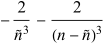 |
(57)
|
 |  | 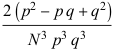 |
(58)
|
 |  | 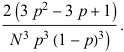 |
(59)
|

Now, treating the distribution as continuous,
 |
(60)
|
Since each term is of order  smaller than the previous, we can ignore terms
higher than
smaller than the previous, we can ignore terms
higher than  ,
so
,
so
 |
(61)
|
The probability must be normalized, so
 |
(62)
|
and
 |  | 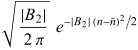 |
(63)
|
 |  | ![1/(sqrt(2piNpq))exp[-((n-Np)^2)/(2Npq)].](/images/equations/BinomialDistribution/Inline169.svg) |
(64)
|
Defining  ,
,
![P(n)=1/(sigmasqrt(2pi))exp[-((n-n^~)^2)/(2sigma^2)],](/images/equations/BinomialDistribution/NumberedEquation22.svg) |
(65)
|
which is a normal distribution. The binomial distribution is therefore approximated by a normal
distribution for any fixed  (even if
  is small) as
  is taken to infinity.
If  and
and  in such a way that
  , then the binomial distribution converges to the
Poisson distribution with mean
, then the binomial distribution converges to the
Poisson distribution with mean  .
.
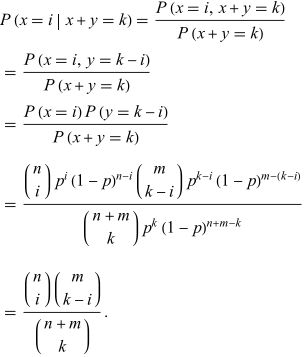
Let  and
and  be independent binomial random variables characterized
by parameters
be independent binomial random variables characterized
by parameters  and
and  .
The conditional probability of
.
The conditional probability of  given that
  is
is
 |
(66)
|
Note that this is a hypergeometric distribution.
