

The sample variance  (commonly written
  or sometimes
  )
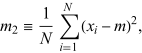
is the second sample central moment and is
defined by
)
is the second sample central moment and is
defined by
 |
(1)
|
where  the sample mean and
  is the sample size.
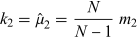
To estimate the population variance  from a sample of
  elements with a priori unknown mean
(i.e., the mean is estimated from the sample itself), we
need an unbiased estimator
elements with a priori unknown mean
(i.e., the mean is estimated from the sample itself), we
need an unbiased estimator  for
for  . This estimator is given
by k-statistic
. This estimator is given
by k-statistic  , which is defined by
 |
(2)
|
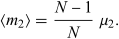
(Kenney and Keeping 1951, p. 189). Similarly, if  samples are taken from a distribution with underlying central
moments
samples are taken from a distribution with underlying central
moments  ,
then the expected value of the observed sample variance
,
then the expected value of the observed sample variance  is
is
 |
(3)
|
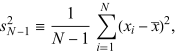
Note that some authors (e.g., Zwillinger 1995, p. 603) prefer the definition
 |
(4)
|
since this makes the sample variance an unbiased estimator for the population variance. The distinction between  and
and  is a common source of confusion, and extreme care
should be exercised when consulting the literature to determine which convention
is in use, especially since the uninformative notation
is a common source of confusion, and extreme care
should be exercised when consulting the literature to determine which convention
is in use, especially since the uninformative notation  is commonly used for both. The unbiased sample variance
  is implemented as Variance[list].
Also note that, in general,  is not an unbiased
estimator of the standard deviation
is not an unbiased
estimator of the standard deviation  even if
  is an unbiased estimator
for
is an unbiased estimator
for  .
.
