The isotomic conjugate of a point is the point of concurrence of the isotomic lines relative
to a point .
The isotomic conjugate of a point with trilinear
coordinates
is
(1)
Vandeghen (1965) calls the transformation taking points to their isotomic conjugates the Cevian transform. The product of isotomic
and isogonal is a collineation
which transforms the sides of a triangle to themselves
(Vandeghen 1965).
An isotomic transversal is sometimes referred
to as an isotomic conjugate (Ehrmann and van Lamoen 2004).
There are four points which are isotomically self-conjugate: the triangle centroid
and each of the exmedian points. The following
table lists some common centers and their isotomic conjugates.
The isotomic conjugate of a line having trilinear equation
(2)
is a conic section circumscribed on the triangle (Casey 1893, Vandeghen 1965).
The isotomic conjugate of the line at infinity
having trilinear equation


 of the isotomic lines relative
to a point
of the isotomic lines relative
to a point  .
The isotomic conjugate
.
The isotomic conjugate  of a point with trilinear
coordinates
of a point with trilinear
coordinates  is
is

 and each of the exmedian points. The following
table lists some common centers and their isotomic conjugates.
and each of the exmedian points. The following
table lists some common centers and their isotomic conjugates.


 having trilinear equation

 (Casey 1893, Vandeghen 1965).
The isotomic conjugate of the line at infinity
having trilinear equation
(Casey 1893, Vandeghen 1965).
The isotomic conjugate of the line at infinity
having trilinear equation

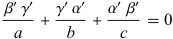
 is transformed is determined by whether the line
  meets the Steiner circumellipse
  .
.
 does not intersect
  , the isotomic transform
is an ellipse.
, the isotomic transform
is an ellipse.
 is tangent to
  ,
the transform is a parabola.
,
the transform is a parabola.
 cuts
cuts  ,
the transform is a hyperbola, which is a rectangular
hyperbola if the line passes through the isotomic conjugate of the orthocenter
,
the transform is a hyperbola, which is a rectangular
hyperbola if the line passes through the isotomic conjugate of the orthocenter
