


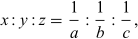
The Steiner circumellipse is the circumellipse that is the isotomic conjugate of the line at infinity and the isogonal conjugate of the Lemoine axis. It has circumconic parameters
 |
(1)
|
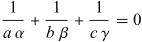
giving trilinear equation
 |
(2)
|
(Vandeghen 1965; Kimberling 1998, p. 236). The Steiner circumellipse is often simply called the "Steiner ellipse," but the designation "circumellipse" is useful to distinguish it from the less important curve known as the Steiner inellipse.

It is the unique ellipse passing through the vertices of a triangle  and having the triangle centroid
  of
of  as its center. The Steiner circumellipse is the also
ellipse of least area that passes through
as its center. The Steiner circumellipse is the also
ellipse of least area that passes through  ,
,  , and
, and  (Kimberling).
The area of the Cevian triangle of any point on the Steiner circumellipse is  , where
  is the area of the reference
triangle.
is the area of the reference
triangle.
The polar triangle of the Steiner circumellipse is the anticomplementary triangle.
The foci of the Steiner circumellipse are known as the Bickart points. The Steiner circumellipse has semiaxes lengths
 |  |  |
(3)
|
 |  |  |
(4)
|
and focal length
 |
(5)
|
where
 |
(6)
|
and has area
 |
(7)
|
where  is the area of the reference triangle (P. Moses,
pers. comm., Dec. 31, 2004).
is the area of the reference triangle (P. Moses,
pers. comm., Dec. 31, 2004).
The intersections of the major and minor axes with the Steiner circumellipse are given by  ,
where
,
where  ,
,
 ,
and
,
and  are given by roots of the quartic equations
 |
(8)
|
 |
(9)
|
 |
(10)
|
Explicitly, the intersections with the major axis are
![1/a[1+/-sqrt((2(Z-a^2)+(b^2+c^2))/Z)]
:1/b[1∓sqrt((2(Z-b^2)+(a^2+c^2))/Z)]
:1/c[1+/-sqrt((2(Z-c^2)+(a^2+b^2))/Z)]](/images/equations/SteinerCircumellipse/NumberedEquation6.svg) |
(11)
|
and the intersections with the minor axis are
![1/a[1+/-sqrt((2(Z+a^2)-(b^2+c^2))/Z)]
:1/b[1∓sqrt((2(Z+b^2)-(a^2+c^2))/Z)]
:1/c[1∓sqrt((2(Z+c^2)-(a^2+b^2))/Z)].](/images/equations/SteinerCircumellipse/NumberedEquation7.svg) |
(12)
|
It passes through Kimberling centers  for
for  (the Steiner point),
190 (Brianchon point of the Yff
parabola), 290, 648, 664, 666, 668, 670, 671, 886, 889, 892, 903, 1121, 1494,
2479, 2480, 2481, and 2966.
(the Steiner point),
190 (Brianchon point of the Yff
parabola), 290, 648, 664, 666, 668, 670, 671, 886, 889, 892, 903, 1121, 1494,
2479, 2480, 2481, and 2966.
The Steiner circumellipse also shares the Steiner point  together with the points
  ,
,  , and
, and  with the circumcircle of
 (Kimberling 1998, p. 236; Kimberling).

The minor axis of the ellipse can be constructed as the angle bisector either of  or
or  , where
  is the Steiner point,
  is the Tarry
point,
is the Tarry
point,  is the circumcenter, and
  is the symmedian point
(Conway 2000). These axes are parallel to the asymptotes of the Kiepert hyperbola
(Conway 2000, Yiu 2003).
is the symmedian point
(Conway 2000). These axes are parallel to the asymptotes of the Kiepert hyperbola
(Conway 2000, Yiu 2003).

Another nice construction is to construct the intersections of the Lemoine axis with the Parry circle and then note that
joining the triangle centroid  with the intersections gives the axes (P. Moses, pers.
comm., Dec. 31, 2004).
with the intersections gives the axes (P. Moses, pers.
comm., Dec. 31, 2004).
The fourth intersection of the Steiner circumellipse with a rectangular circumhyperbola  for
for  has center function
![alpha_P=1/(a[abetagamma-(balphabeta+calphagamma)cosA]),](/images/equations/SteinerCircumellipse/NumberedEquation8.svg) |
(13)
|
which is the isogonal conjugate of the intersection of the line through the circumcenter and the isogonal
conjugate of  and the Lemoine axis. The following table summarizes
these points for various named rectangular circumhyperbolas (P. Moses, pers.
comm., Dec. 31, 2004).
and the Lemoine axis. The following table summarizes
these points for various named rectangular circumhyperbolas (P. Moses, pers.
comm., Dec. 31, 2004).
| circumhyperbola | Kimberling |
| Feuerbach hyperbola |  |
| Jerabek hyperbola |  |
| Kiepert hyperbola |  |
