Pick three points ,
,
and
distributed independently and uniformly in a unit disk (i.e., in the interior of the unit
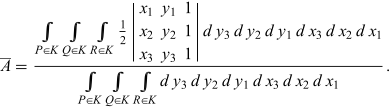
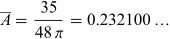
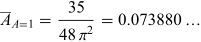
circle). Then the average area of the triangle determined
by these points is
for unit-area disks (OEIS A093587; Woolhouse 1867; Solomon 1978; Pfiefer 1989; Zinani 2003). This problem is very closely related
to Sylvester's four-point problem,
and can be derived as the limit as of the general polygon
triangle picking problem.
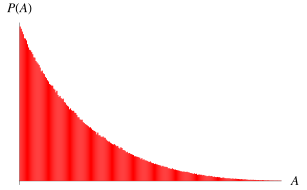
The distribution of areas, illustrated above, is apparently not known exactly.
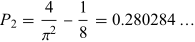
The probability
that three random points in a disk form an acute triangle
is
(9)
(OEIS A093588; Woolhouse 1886). The problem was generalized by Hall (1982) to -dimensional ball triangle
picking, and Buchta (1986) gave closed form evaluations for Hall's integrals.
Buchta, C. "Zufallspolygone in konvexen Vielecken." J. reine angew. Math.347, 212-220, 1984.Buchta, C. "A
Note on the Volume of a Random Polytope in a Tetrahedron." Ill. J. Math.30,
653-659, 1986.Guy, R. K. "There are Three Times as Many Obtuse-Angled
Triangles as There are Acute-Angled Ones." Math. Mag.66, 175-178,
1993.Hall, G. R. "Acute Triangles in the -Ball." J. Appl. Prob.19, 712-715, 1982.Pfiefer,
R. E. "The Historical Development of J. J. Sylvester's Four Point
Problem." Math. Mag.62, 309-317, 1989.Sloane, N. J. A.
Sequences A093587, A093588,
and A189511 in "The On-Line Encyclopedia
of Integer Sequences."Solomon, H. Geometric
Probability. Philadelphia, PA: SIAM, 1978.Woolhouse, W. S. B.
"Solution to Problem 1350." Mathematical Questions, with Their Solutions,
from the Educational Times, Vol. 1. London: F. Hodgson and Son, pp. 22-23,
Jul. 1863-Jun. 1864.Woolhouse, W. S. B. "Some
Additional Observations on the Four-Point Problem." Mathematical Questions,
with Their Solutions, from the Educational Times, Vol. 7. London: F. Hodgson
and Son, p. 81, 1867.Zinani, A. "The Expected Volume of a
Tetrahedron Whose Vertices are Chosen at Random in the Interior of a Cube."
Monatshefte Math.139, 341-348, 2003.



 ,
,
 ,
and
,
and  distributed independently and uniformly in a unit disk
  (i.e., in the interior of the unit
circle). Then the average area of the triangle determined
by these points is
(i.e., in the interior of the unit
circle). Then the average area of the triangle determined
by these points is









 of the general polygon
triangle picking problem.
of the general polygon
triangle picking problem.
 that three random points in a disk form an acute triangle
is
that three random points in a disk form an acute triangle
is
 -dimensional ball triangle
picking, and Buchta (1986) gave closed form evaluations for Hall's integrals.
-dimensional ball triangle
picking, and Buchta (1986) gave closed form evaluations for Hall's integrals.

 -Ball." J. Appl. Prob. 19, 712-715, 1982.Pfiefer,
R. E. "The Historical Development of J. J. Sylvester's Four Point
Problem." Math. Mag. 62, 309-317, 1989.Sloane, N. J. A.
Sequences
-Ball." J. Appl. Prob. 19, 712-715, 1982.Pfiefer,
R. E. "The Historical Development of J. J. Sylvester's Four Point
Problem." Math. Mag. 62, 309-317, 1989.Sloane, N. J. A.
Sequences