

Let  be an edge-labeled acyclic digraph with distinguished
source
be an edge-labeled acyclic digraph with distinguished
source  and target
  ,
and let
,
and let  be the label of edge
  .
The
.
The  -
- path polynomial of
  is
is
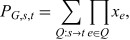 |
where the sum is over all directed graph paths  from
from  to
to  and the product is taken in the order in which the edges occur
along
and the product is taken in the order in which the edges occur
along  .
It is naturally a polynomial in the free noncommutative semiring,
although commutative specializations are also useful. After adjoining additive inverses,
the same expression lies in a free noncommutative
ring.
.
It is naturally a polynomial in the free noncommutative semiring,
although commutative specializations are also useful. After adjoining additive inverses,
the same expression lies in a free noncommutative
ring.
An  -
- path expression, also called a factoring
of
path expression, also called a factoring
of  ,
is a formula using addition, multiplication, and the edge labels that represents
,
is a formula using addition, multiplication, and the edge labels that represents
 .
Its length is the number of edge-label occurrences in the formula tree. This measure
counts repeated subexpressions each time they occur and therefore differs from the
size of a shared algebraic branching program
or circuit.
.
Its length is the number of edge-label occurrences in the formula tree. This measure
counts repeated subexpressions each time they occur and therefore differs from the
size of a shared algebraic branching program
or circuit.
Setting the labels of a set  of edges to 0 makes
  vanish if and only if
  is an
is an  -
- edge cut. Moreover,
  is inclusion-minimal if and only if the polynomial remains
nonzero when the zero substitution is instead made for any proper
subset of
is inclusion-minimal if and only if the polynomial remains
nonzero when the zero substitution is instead made for any proper
subset of  (Korenblit and Levit 2026).
This polynomial should not be confused with the path polynomial  ,
whose coefficient
,
whose coefficient  counts graph paths of length
  .
.
