

A  -complete
poset is a finite partially
ordered set satisfying local completion and nonoverlap axioms for double-tailed
diamonds. For each
 ,
let
 consist of two incomparable elements, a chain of
 elements below both, and a chain
of
 elements above both. An order interval
 is a
 -interval when it is isomorphic to
 . A
 -convex subset is a copy of
 with its maximum removed that contains every element
lying between two of its elements. The axioms require that every such subset can
be completed to a
 -interval,
that the maximum of a
 -interval
covers no element outside the interval, and that no two
 -convex subsets differ only in their minimal elements (Nguyen
et al. 2026, Definition 4).
Rooted trees and the partial orders associated with ordinary and shifted Young tableaux give examples with the
order conventions of Nguyen et al. (2026). The number of linear
extensions of a  -complete
poset
 satisfies the hook length formula
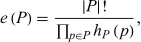 |
where the hook length is defined recursively. If  is not a neck element (one lying above the two incomparable
sides) of any double-tailed diamond interval, then
 is the number of elements at or below
 . If
 is the maximum of such an interval
 with incomparable side elements
 , then
 . Nguyen et al. (2026) give
a purely combinatorial proof of a multivariate version
using a generalization of the Robinson-Schensted-Knuth
correspondence.

 -Complete
Posets." Elec. J. Combin. 33, P4.1, 2026.