The zero forcing number of a graph is the minimum number of vertices
in a zero forcing set of . It is a graph parameter
that is closely related to the maximum nullity and that bounds it from above:
(AIM 2008, Barrett et al. 2025).
Results from the American Institute of Mathematics (2008) showed that for any graph on 6 or fewer
vertices. DeLoss et al. (2008) subsequently
computed
and bounds on
for all 7-vertexgraphs,
and the resulting table establishes that for all graphs on 7 vertices
(Barrett et al. 2025). Barrett et al. (2025) subsequently showed that
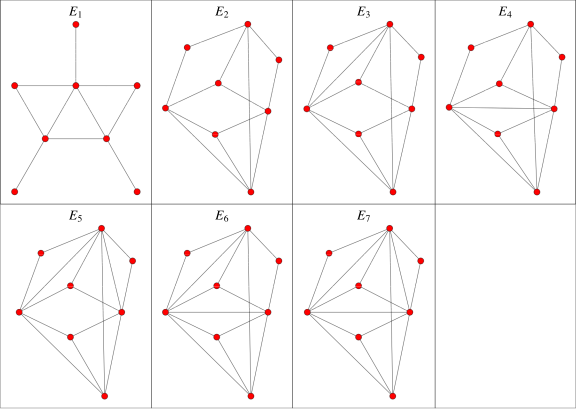
for all graphs on 8 vertices
with the exception of a set of 7 graphs
denoted
to
and which are illustrated above. As it turns out, is the graph complement
of the 3-Plummer-Toft graph.
For the generalized Petersen graphs with and , the general upper bound
is
(Alameda et al. 2018, p. 58). Previously known exact values include the
prism graph values and for (Alameda et al. 2018, p. 58). Alameda et
al. (2018, p. 60) also proved for every integer. Rashidi et al. (2020, pp. 185 and
189-190) proved
for
and
for . Krishnan et al. (2026) give the exact
values for all members of the generalized
Petersen graph subfamilies and : for every and for every . The smaller values of
for , 8, ..., 12 are 6, 6, 6, 8, 7, 7, and those of for , 10, ..., 17 are 6, 6, 7, 6, 8, 8, 9, 8, 9. Krishnan
et al. (2026) report AI assistance with computational code and Lean development
for the
stabilization theorem.
For maximal biconnectedouterplanar graphs, Han and Liang (2026) report an exact formula and a linear-time algorithm
that constructs a minimum zero forcing set and
its forcing chronology from indexed triangle adjacency. Their formula accounts for
obstructions to orienting a minimum path cover into a valid forcing process. Han
and Liang (2026) explicitly state that the AI-assisted mathematical derivations and
computations are still being checked and rewritten. These reported results remain
provisional.
Abiad, A.; Flagg, M.; Ghasemi Nezhad, S.; and Zeijlemaker, S. "The Zero Forcing Number of Graph Powers." 2 Oct 2026. https://arxiv.org/abs/2610.03892.AIM
Minimum Rank--Special Graphs Work Group. "Zero Forcing Sets and the Minimum
Rank of Graphs." Lin. Alg. Appl.428, 1628-1648, 2008.Alameda,
J. S.; Curl, E.; Grez, A.; Hogben, L.; Kingston, O.; Schulte, A.; Young, D.;
and Young, M. "Families of Graphs with Maximum Nullity Equal to Zero Forcing
Number." Special Matrices6, 56-67, 2018. https://doi.org/10.1515/spma-2018-0006.Almodovar,
E.; DeLoss, L.; Hogben, L.; Hogenson, K.; Murphy, K.; Peters, T.; and Ramírez,
C. A. "Minimum Rank, Maximum Nullity and Zero Forcing Number for Selected Graph
Families." Involve: A Journal of Mathematics3, 371-392, 2010.American
Institute of Mathematics. "Graph Catalog: Families of Graphs." https://aimath.org/WWN/matrixspectrum/catalog2.html.American
Institute of Mathematics. "AIM Minimum Rank Graph Catalog." http://admin.aimath.org/resources/graph-invariants/minimumrankoffamilies/#/super.American
Institute of Mathematics. "AIM Minimum Rank Graph Catalog References."
https://web.archive.org/web/20160207084159/http://orion.math.iastate.edu/lhogben/AIMmrgraphcatrefs.pdf.Barrett,
W.; Hunnell, M.; Hutchens, J.; and Sinkovic, J. "The Classification of Graphs
on 8 Vertices with Coinciding Zero Forcing Number and Maximum Nullity." 12 Jun
2025. https://arxiv.org/abs/2506.10726.Barrett,
W.; van der Holst, H.; and Loewy, R. "Graphs Whose Minimal Rank Is Two."
Elec. J. Lin. Alg.11, 258-280, 2004.DeLoss, L.; Grout,
J.; Hogben, L.; McKay, T.; Smith, J.; and Tims, J. "Table of Minimum Ranks of
Graphs of Order at Most 7 and Selected Optimal Matrices." 4 Dec 2008. https://arxiv.org/abs/0812.0870.Fallat,
S. M. and Hogben, L. "Minimum Rank, Maximum Nullity, and Zero Forcing Number
of Graphs." Ch. 46 in Handbook of Linear Algebra, 2nd ed. Boca Raton,
FL: CRC Press, 2014.Han, Z. and Liang, Y. "Zero Forcing on Maximal
Outerplanar Graphs: Capacities and Phase Repair." 22 Oct 2026. https://arxiv.org/abs/2610.31138.Krishnan,
A.; Ma, H.; and Zhang, W. "Sharp Zero Forcing Numbers for the Generalized Petersen
Graphs
and ."
16 Oct 2026. https://arxiv.org/abs/2610.24059.Nylen,
P. M. "Minimum-Rank Matrices With Prescribed Graph." Lin. Alg.
Appl.248, 303-316, 1996.Rashidi, S.; Shajareh Poursalavati,
N.; and Tavakkoli, M. "Computing the Zero Forcing Number for Generalized Petersen
Graphs." J. Algebra Combin. Discrete Struct. Appl.7, 183-193,
2020. https://doi.org/10.13069/jacodesmath.729465.


 of a graph
 is the minimum number of vertices
in a zero forcing set of
 . It is a graph parameter
that is closely related to the maximum nullity
 and that bounds it from above:

 for any graph on 6 or fewer
vertices. DeLoss et al. (2008) subsequently
computed
 and bounds on
 for all 7-vertex graphs,
and the resulting table establishes that
 for all graphs on 7 vertices
(Barrett et al. 2025). Barrett et al. (2025) subsequently showed that
 for all graphs on 8 vertices
with the exception of a set of 7 graphs
denoted
 to
 and which are illustrated above. As it turns out,
 is the graph complement
of the 3-Plummer-Toft graph.
 for every graph
 and
 . They also establish the
corresponding monotonicity for the b-forcing
number, whose rule allows a colored vertex with
at most
 uncolored neighbors to force all of those neighbors
at once, and for the positive
semidefinite zero forcing number.
 for
 and
 for
 , where
 and
 is the maximum nullity
(Abiad et al. 2026). The family formulas are drawn from earlier results on
minimum rank.
 with
 and
 , the general upper bound
is
 (Alameda et al. 2018, p. 58). Previously known exact values include the
prism graph values
 and
 for
 (Alameda et al. 2018, p. 58). Alameda et
al. (2018, p. 60) also proved
 for every integer
 . Rashidi et al. (2020, pp. 185 and
189-190) proved
 for
 and
 for
 . Krishnan et al. (2026) give the exact
values for all members of the generalized
Petersen graph subfamilies
 and
 :
 for every
 and
 for every
 . The smaller values of
 for
 , 8, ..., 12 are 6, 6, 6, 8, 7, 7, and those of
 for
 , 10, ..., 17 are 6, 6, 7, 6, 8, 8, 9, 8, 9. Krishnan
et al. (2026) report AI assistance with computational code and Lean development
for the
 stabilization theorem.

 and
 ."
16 Oct 2026.