


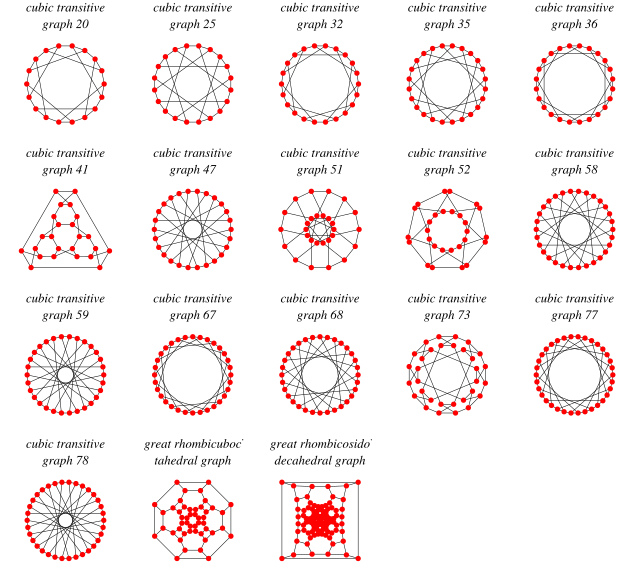
A zero-symmetric graph is a vertex-transitive cubic graph whose edges are partitioned into three orbits by its automorphism group. The figures above show some small zero-symmetric graphs.
A vertex-transitive cubic graph cannot be zero-symmetric if a graph automorphism fixes a graph vertex and exchanges two of its incident edges. Those two edges belong to the same group orbit. Since the graph is vertex-transitive, every group orbit on edges has a representative incident to the fixed graph vertex, so there can be at most two such orbits.
In particular, no cubic circulant graph is zero-symmetric. The three neighbors of graph
vertex 0 are  ,
 ,
and
 modulo the even graph order
 , where
 . The graph
automorphism
 fixes 0 and exchanges the incident edges to
 and
 .

A drawing of the smallest zero-symmetric graph appears on the cover of Coxeter et al. (1981) and on p. 5.
