

The work function algorithm is an online algorithm that chooses its next state using the optimal offline costs for the input revealed
so far. In the k-server problem, let  be the minimum cost of serving
the first
be the minimum cost of serving
the first  requests from a specified initial configuration and then ending with the servers
at configuration
requests from a specified initial configuration and then ending with the servers
at configuration  .
This function is the work function. It can be updated
from
.
This function is the work function. It can be updated
from  by dynamic programming.
The distance between configurations  and
and  is the minimum total distance
required to move the servers from one configuration to the other,
is the minimum total distance
required to move the servers from one configuration to the other,
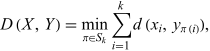 |
where  is the underlying metric and
  is the symmetric group
of permutations of the
is the symmetric group
of permutations of the  servers. If the current configuration is
  and the next request is
  , the work function algorithm chooses
![C_t in argmin_(X:r_t in X)[w_t(X)+D(C_(t-1),X)].](/images/equations/WorkFunctionAlgorithm/NumberedEquation2.svg) |
Thus the chosen configuration must contain the requested point, and ties may be broken arbitrarily. Configurations are multisets of server locations, so multiple servers may occupy the same point.
Koutsoupias and Papadimitriou (1995) proved a competitive ratio of at most  for the k-server
problem. Coester et al. (2026) reported the optimal competitive
ratio
for the k-server
problem. Coester et al. (2026) reported the optimal competitive
ratio  ,
with independent specialist verification and external peer review not reported as
of Sep. 18, 2026.
,
with independent specialist verification and external peer review not reported as
of Sep. 18, 2026.

 -Server
Conjecture Is True." 14 Sep 2026.
-Server
Conjecture Is True." 14 Sep 2026.  -Server Conjecture." J. ACM 42, 971-983,
1995.
-Server Conjecture." J. ACM 42, 971-983,
1995.