

The Wigner distribution of a square-integrable complex function  is the time-frequency function
 |
(1)
|
Its marginal integrals, interpreted weakly when necessary, recover the position and frequency energy densities,
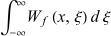 |  |  |
(2)
|
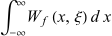 |  |  |
(3)
|
where  is the Fourier transform with kernel
 . If
 , both marginals are probability density functions. Under
this normalization, the real-valued Wigner distribution is a quasiprobability distribution,
since it need not be nonnegative and therefore need not be a joint probability
density function.
For a normalized wave function  , the momentum convention used
in quantum mechanics is
 |
(4)
|
where  is momentum and
 is the reduced Planck constant (Case 2008, p. 938). The factor
 ensures that the integral of
 over phase space is 1.
For the quantum harmonic oscillator with Hamiltonian
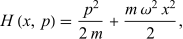 |
(5)
|
where  and
 , the normalized stationary wave functions
are scaled Hermite functions. Their Wigner functions
are
 |
(6)
|
where  , 1, 2,
 ,
 is a Laguerre polynomial,
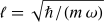 , and
 (Curtright et al. 1998). The ground
state
 gives a positive Gaussian function, whereas
the first excited state has
 . A coherent
state, obtained by displacing the ground state to position
 and momentum
 , has the Gaussian
function (Case 2008, pp. 940-942)
 |
(7)
|
For a time-independent Hamiltonian  with
 a polynomial of degree
at most 2, the exact quantum evolution of the Wigner function
 obeys the classical transport equation
 |
(8)
|
where  is the Poisson bracket. The quantum corrections
vanish because they contain derivatives of
 of order at least 3 (Case 2008, pp. 941-942). If
 is the flow determined by Hamilton's
equations, then
 |
(9)
|
For the harmonic oscillator this is a rigid clockwise rotation in the scaled coordinates  with angular speed
 , for every initial state. In particular, a coherent
state's Gaussian function retains its shape
while its center follows the classical orbit.
