TOPICS
Search

Weight Enumerator


The weight enumerator of a code C of length n records how many codewords have each Hamming weight. If A_i is the number of codewords with i nonzero coordinates, its homogeneous form is
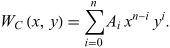
 W_C(x,y)=sum_(i=0)^nA_ix^(n-i)y^i.

The univariate convention is W_C(y)=W_C(1,y) (MacWilliams and Sloane 1977).

For a linear code of dimension k over F_q, the enumerator of its dual code satisfies

 W_(C^_|_)(x,y)=q^(-k)W_C(x+(q-1)y,x-y).

This is the MacWilliams identity (MacWilliams 1963). For self-dual codes, equality of the two enumerators imposes strong coefficient constraints.


See also

Dual Code, Hamming Weight, Self-Dual Code

Explore with Wolfram|Alpha

References

MacWilliams, F. J. "A Theorem on the Distribution of Weights in a Systematic Code." Bell System Tech. J. 42, 79-94, 1963. https://doi.org/10.1002/j.1538-7305.1963.tb04003.x.MacWilliams, F. J. and Sloane, N. J. A. The Theory of Error-Correcting Codes. Amsterdam, Netherlands: North-Holland, 1977.

Cite this as:

Weisstein, Eric W. "Weight Enumerator." From MathWorld--A Wolfram Resource. https://mathworld.wolfram.com/WeightEnumerator.html

Subject classifications
