


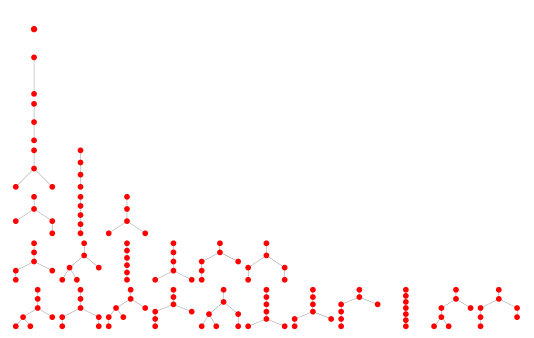
A weakly binary tree with at least two graph vertices is a planted tree in which all nonroot graph vertices are adjacent to at most three graph vertices. By convention, the one-vertex rooted tree is also counted as a degenerate weakly binary tree.
Let
 |
(1)
|
be the generating function for the number of weakly binary trees on  nodes, where
 |  |  |
(2)
|
 |  |  |
(3)
|
 |  |  |
(4)
|
 |  |  |
(5)
|
Here the recurrences for  and
 apply for integers
 . This gives the sequence
1, 1, 1, 2, 3, 6, 11, 23, 46, 98, 207, ... (OEIS A001190),
sometimes also known as the Wedderburn-Etherington numbers.
Otter (1948) showed that (Harary and Palmer 1973, Knuth 1997)
 |
(6)
|
where
 |
(7)
|
(OEIS A086317; Knuth 1997, p. 583; Finch 2003, p. 297) is the unique positive root of
 |
(8)
|
and
 |
(9)
|
(OEIS A086318; Knuth 1997, p. 583).  is also given by the rapidly converging
limit
 |
(10)
|
where  is given by
 |  |  |
(11)
|
 |  |  |
(12)
|
for integers  in the recurrence. The values
 are 6, 38, 1446, 2090918, 4371938082726, ... (OEIS
A072191), giving
 |
(13)
|

 ." Ann. Math. 24,
121-140, 1922-1923.