

Vinogradov's theorem, also called Vinogradov's three-primes theorem, states that every sufficiently large odd number is a sum of three
primes (Vinogradov 1937). Its full statement estimates
a weighted number of such representations. For odd  , let
, let
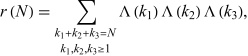 |
where  is the Mangoldt function. For every fixed
  ,
,
 |
where  is a positive singular series. This asymptotic
formula implies the existence of a representation for every sufficiently large odd
is a positive singular series. This asymptotic
formula implies the existence of a representation for every sufficiently large odd
 .
.
Hardy and Littlewood (1923) had obtained the conclusion conditionally on the generalized Riemann hypothesis. Vinogradov made it unconditional in 1937 using exponential-sum estimates and the circle method. Helfgott later proved that every odd number greater than 5 is a sum of three primes (Helfgott 2014). This completed the weak Goldbach conjecture, also called the ternary Goldbach conjecture. Helfgott's theorem strengthens the existence conclusion from sufficiently large odd integers to all relevant odd integers, while Vinogradov's asymptotic formula remains a stronger counting result.
Vinogradov's theorem is distinct from the Bombieri-Vinogradov theorem. The latter concerns primes in arithmetic progressions and is named in part for A. I. Vinogradov, rather than I. M. Vinogradov. Vinogradov's theorem is also closely related to Waring's prime number conjecture.
