

The two envelopes paradox concerns two indistinguishable envelopes containing positive amounts of money, one exactly twice the other. A player chooses one envelope, observes or does not observe its contents depending on the version, and is then offered the opportunity to switch.
The tempting argument assigns equal probabilities to the other envelope containing half or twice the chosen amount  , giving an apparent expectation
value
, giving an apparent expectation
value
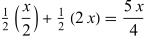 |
for switching. Applied before either envelope is opened, the same argument recommends switching repeatedly, even though the two envelopes have a symmetry exchanging them.
The error is that the two alternatives cannot in general be assigned probability  conditional on the observed amount
without specifying a probability model for the smaller
amount. Once such a model is supplied, conditional
probabilities depend on the observed value and the contradiction disappears.
conditional on the observed amount
without specifying a probability model for the smaller
amount. Once such a model is supplied, conditional
probabilities depend on the observed value and the contradiction disappears.
