


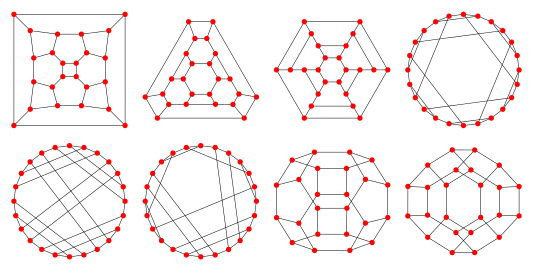
The truncated octahedral graph is the cubic Archimedean graph on 24 nodes and 36 edges
that is the skeleton of the truncated
octahedron. It is isomorphic to the Bruhat
graph  ,
meaning it is the graph having all permutations
of
 as vertices with an edge
between pairs of permutations that differ by an adjacent
transposition.
It is implemented in the Wolfram Language as GraphData["TruncatedOctahedralGraph"].
The truncated octahedral graph is vertex-transitive but not edge-transitive. It is Hamiltonian.
It has LCF notations  ,
 , and [
 , 5,
 ,
 ,
 , 3,
 , 5,
 , 9, 7, 3,
 , 11,
 , 7, 5,
 ,
 , 9, 7,
 ,
 , 3].
It has graph spectrum  . Its
automorphism group is of group
order
 .
The truncated octahedral graph is also its own distance-5 graph distance graph.
Its domination number is 8 and its bondage number is 5 (Srivastava 2026). Since the truncated octahedral graph is cubic
and planar, its maximum
vertex degree is 3, making it a counterexample
to the planar bondage conjecture  proposed by Dunbar et al. (1998). Srivastava (2026) reports using OpenAI Codex
for search-code development and independent-check design.
