


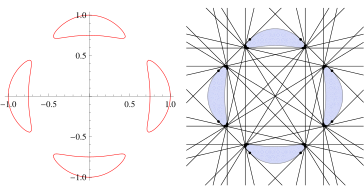
The Trott curve is a simple example of a quartic curve having 28 real bitangents-the maximum possible for a quartic curve-given by the equation
 |
(1)
|
(Trott 1997).
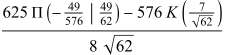
The four ovals have total area
 |  |  |
(2)
|
 |  |  |
(3)
|
(E. Weisstein, Sep. 23, 2026). Here  is the complete
elliptic integral of the first kind with elliptic
modulus
is the complete
elliptic integral of the first kind with elliptic
modulus  ,
while
,
while  is the complete
elliptic integral of the third kind with elliptic
characteristic
is the complete
elliptic integral of the third kind with elliptic
characteristic  and parameter
  . Each oval has area
  .
.
The area moment of inertia tensor of the region enclosed by all four ovals, about the origin, is
 |  | ![(25[17856E(7/(sqrt(62)))-183744K(7/(sqrt(62)))+195631Pi(-(49)/(576)|(49)/(62))])/(326656sqrt(62))I](/images/equations/TrottCurve/Inline15.svg) |
(4)
|
 |  |  |
(5)
|
(E. Weisstein, Sep. 24, 2026), where  is the
  identity matrix
and
identity matrix
and  is the complete
elliptic integral of the second kind with elliptic
modulus
is the complete
elliptic integral of the second kind with elliptic
modulus  .
.
