TOPICS
Search

Triangle Inequalities


Triangle inequalities bound combinations of the sides, angles, and other geometric quantities of a triangle. Let a triangle have angles A, B, and C, then inequalities include

sinA+sinB+sinC<=3/2sqrt(3)
(1)
1<=cosA+cosB+cosC<=3/2
(2)
sin(1/2A)sin(1/2B)sin(1/2C)<=1/8
(3)
tan(1/2A)+tan(1/2B)+tan(1/2C)>=sqrt(3)
(4)
cotAcotBcotC<=1/9sqrt(3)
(5)
cotA+cotB+cotC>=sqrt(3)
(6)
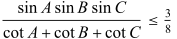
(sinAsinBsinC)/(cotA+cotB+cotC)<=3/8
(7)
(tan(1/2A)+tan(1/2B)+tan(1/2C))/(tan(1/2A)tan(1/2B)tan(1/2C))>=9
(8)
cos(1/2A)cos(1/2B)cos(1/2C)>=sinAsinBsinC
(9)
>=sin(2A)sin(2B)sin(2C)
(10)
2<=cos^2(1/2A)+cos^2(1/2B)+cos^2(1/2C)<=9/4
(11)
cot(1/2A)cot(1/2B)+cot(1/2B)cot(1/2C)+cot(1/2C)cot(1/2A)>=9
(12)

(Siddons and Hughes 1929, p. 283), and

 (sinA+sinB+sinC)/(cotA+cotB+cotC)<=3/2
(13)

(Weisstein).

Another symmetric inequality is

 cosAcosBcosC<=1/8,
(14)

with equality iff the triangle is an equilateral triangle (Trott 2006).

Trott (2006) uses quantifier elimination to establish bounds for weighted cosine sums of the angles of a triangle. For the first sum, his strict lower bound of 0 can be strengthened to 1, giving

 1<cosA+sqrt(2)(cosB+cosC)<=2,
(15)

where the upper bound is attained iff A=pi/2 and B=C=pi/4. The stronger lower bound follows from cosA+cosB+cosC>1 and cosB+cosC>0. For the second sum, Trott's bounds of 0 and 4 are strict for nondegenerate triangles, so

 0<cosA+2cosB+3cosC<4.
(16)

For the first weighted sum, the lower bound is approached as (A,B,C) tends to (0,0,pi). For the second, the lower bound and upper bound are approached as (A,B,C) tends to (0,0,pi) and (pi,0,0), respectively. None of these limiting bounds is attained by a nondegenerate triangle.

For side lengths a, b, and c, let s=(a+b+c)/2 be the semiperimeter, R the circumradius, r the inradius, and m_a the length of the triangle median to the side of length a. Two further inequalities are

 b^2+c^2<=4Rm_a,
(17)

with equality iff the triangle is an isosceles triangle with b=c or a right triangle with hypotenuse a (Trott 2006). Also,

 2s^2>=27Rr,
(18)

with equality iff the triangle is an equilateral triangle (Bjelica 1995, Trott 2006). The second inequality follows from Rr=abc/(4s) and (a+b+c)^3>=27abc. Another side-length inequality is Padoa's inequality.



See also

Padoa's Inequality, Triangle Inequality

Explore with Wolfram|Alpha

References

Bjelica, M. "An Inequality for the Triangle." Filomat 9, 117-120, 1995.Bottema, O.; Djordjević, R. Z.; Janić, R. R.; Mitrinović, D. S.; and Vasić, P. M. Geometric Inequalities. Groningen, Netherlands: Wolters-Noordhoff, 1969.Djordjević, R. Ž. "Some Inequalities for Triangle: Old and New Results." In Analytic and Geometric Inequalities and Applications. (Ed. T. M. Rassias and H. M. Srivastava). Dordrecht, Netherlands: Kluwer, pp. 69-92, 1999. https://doi.org/10.1007/978-94-011-4577-0_6.Mitrinović, D. S.; Pečarić, J. E.; and Volenec, V. Recent Advances in Geometric Inequalities. Dordrecht, Netherlands: Kluwer, 1989. https://doi.org/10.1007/978-94-015-7842-4.Siddons, A. W. and Hughes, R. T. Trigonometry, Parts III-IV. London, England: Cambridge University Press, 1929.Trott, M. "Polynomials in Inequalities." §1.2.3 in The Mathematica GuideBook for Symbolics. New York: Springer-Verlag, 2006. https://doi.org/10.1007/0-387-28815-5. https://www.mathematicaguidebooks.org/.

Referenced on Wolfram|Alpha

Triangle Inequalities

Cite this as:

Weisstein, Eric W. "Triangle Inequalities." From MathWorld--A Wolfram Resource. https://mathworld.wolfram.com/TriangleInequalities.html

Subject classifications