

The total absolute curvature of a two-dimensional surface  is the integral
 |
where  is its Gaussian curvature at a point
 and
 is its area element (White 2016, p. 15). It
is nonnegative and may be infinite.
The signed total curvature is instead  . When
 is absolutely integrable, the triangle
inequality for integrals gives
 . For a minimal
surface in three-dimensional Euclidean space,
 , so its total absolute curvature is the negative
of its signed total curvature. This identity includes
infinite total absolute curvature and signed total
curvature
 .
For a regular, twice continuously differentiable space curve  parametrized by arc length
 , the total absolute curvature, often simply called
total curvature, is
 |
where  is the nonnegative curvature (Milnor 1953). For an
oriented plane curve with signed curvature
 , the same quantity is
 . This integral differs from the third-curvature
convention involving
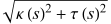 ,
where
 is the torsion and these classical quantities are defined.
