


The theta series of a point lattice  is the generating function
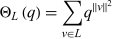 |
for  , where
  is the Euclidean vector norm.
The coefficient of
is the Euclidean vector norm.
The coefficient of 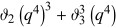 counts the vectors with squared
vector norm
counts the vectors with squared
vector norm  in the point lattice.
Theta series for a number of point lattices are implemented in the Wolfram Language as LatticeData[lattice, "ThetaSeriesFunction"].
The following table summarizes point lattices with closed-form theta series. Here, 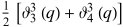 is a Jacobi
theta function.
is a Jacobi
theta function.
| lattice | theta series generating function |
| Barnes-Wall lattice | ![1/2[theta_2^(16)(q)+theta_3^(16)(q)+theta_4^(16)(q)+30theta_2^8(q)theta_3^8(q)]](/images/equations/ThetaSeries/Inline7.svg) |
| body-centered cubic lattice | 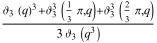 |
| Coxeter-Todd lattice | ![9/(32)theta_2^6(q)theta_2(q^3)^6+[theta_2(q^4)theta_2(q^(12))+theta_3(q^4)theta_3(q^(12))]^6+(45)/(16)theta_2^4(q)[theta_2(q^4)theta_2(q^(12))+theta_3(q^4)theta_3(q^(12))]^2theta_2^4(q^3)](/images/equations/ThetaSeries/Inline9.svg) |
| face-centered cubic lattice | ![1/2[theta_3^3(q)+theta_4^3(q)]](/images/equations/ThetaSeries/Inline10.svg) |
| hexagonal close packing lattice | ![1/2theta_2(q^(8/3))[theta_2(q^(2/3))theta_2(q^2)+theta_3(q^(2/3))theta_3(q^2)]+[theta_3(q^(8/3))-1/2theta_2(q^(8/3))](theta_2(q^2)theta_2(q^6)+theta_3(q^2)theta_3(q^6))](/images/equations/ThetaSeries/Inline11.svg) |
| hexagonal lattice |  |
| Leech lattice | ![1/8[theta_2^8(q)+theta_3^8(q)+theta_4^8(q)]^3-(45)/(16)theta_2^8(q)theta_3^8(q)theta_4^8(q)](/images/equations/ThetaSeries/Inline13.svg) |
| simple cubic lattice |  |
| square lattice |  |
| tetrahedral packing lattice | ![1/2[theta_2^3(q)+theta_3^3(q)+theta_4^3(q)]](/images/equations/ThetaSeries/Inline16.svg) |
The following table gives the first few terms of the series for these point lattices.
| lattice | OEIS | theta series |
| Barnes-Wall lattice | A008409 |  |
| body-centered cubic lattice | A004013 |  |
| Coxeter-Todd lattice | A004010 |  |
| face-centered cubic lattice | A004015 |  |
| hexagonal close packing lattice |  | |
| hexagonal lattice |  | |
| Leech lattice | A008408 |  |
| simple cubic lattice | A005875 |  |
| square lattice | A004018 |  |
| tetrahedral packing lattice |  |
Writing  ,
for a point lattice
,
for a point lattice  with covolume 1, Luo
and Wei (2026) proved that
with covolume 1, Luo
and Wei (2026) proved that  is minimized for every
  uniquely, up to an orthogonal
transformation, by the rescaled D4
lattice
uniquely, up to an orthogonal
transformation, by the rescaled D4
lattice  .
Their computer-assisted proof uses certified interval bounds. Luo and Wei (2026) state that ChatGPT assisted with
review of proof arguments and citations and with preparation
of the computational verification materials.
.
Their computer-assisted proof uses certified interval bounds. Luo and Wei (2026) state that ChatGPT assisted with
review of proof arguments and citations and with preparation
of the computational verification materials.
