

Thābit ibn Qurra's rule gives a sufficient condition for constructing an amicable pair. The rule dates
back to the ninth century (Woepcke 1852, Escott 1946, Borho 1972; Dickson 2005, pp. 5
and 39). Take an integer  and suppose that
 |  |  |
(1)
|
 |  |  |
(2)
|
 |  |  |
(3)
|
are all prime. Then  are an amicable pair,
where
are an amicable pair,
where  is sometimes called a Thābit ibn Qurra
number. This form was rediscovered by Fermat in 1636 and Descartes in 1638 and
generalized by Euler to Euler's rule (Borho 1972).
is sometimes called a Thābit ibn Qurra
number. This form was rediscovered by Fermat in 1636 and Descartes in 1638 and
generalized by Euler to Euler's rule (Borho 1972).
The rule requires that both  and
and  occur among the exponents for which
  is prime (OEIS
A002235). For
is prime (OEIS
A002235). For  , 4, and 7, all three numbers
  ,
,  , and
, and  are prime, giving the amicable
pairs (220, 284), (17296, 18416), and (9363584, 9437056).
are prime, giving the amicable
pairs (220, 284), (17296, 18416), and (9363584, 9437056).
In fact, various rules can be found that are analogous to Thābit ibn Qurra's. Denote a "Thābit rule" by  for given positive
integers
for given positive
integers  and
and  ,
a prime
,
a prime  not dividing
  , and polynomials
 ![F_1(X),F_2(X) in Z[X]](/images/equations/ThabitibnQurraRule/Inline25.svg) , with
, with  for
for  , 2, and fixed
  ,
,  independent of
  . Then a necessary condition
for the set of amicable pairs
. Then a necessary condition
for the set of amicable pairs  of the form
  (
( , 2) with
  ,
,  prime and
  a positive integer to
be infinite is that
a positive integer to
be infinite is that
 |
(4)
|
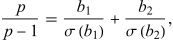
where  is the divisor function (Borho 1972). Assuming
this balance condition, the numbers
is the divisor function (Borho 1972). Assuming
this balance condition, the numbers  (
( , 2) form an amicable pair
if
, 2) form an amicable pair
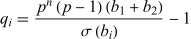
if  and for some positive integer
  , both
 |
(5)
|
for  ,
2 are prime integers not dividing
,
2 are prime integers not dividing  (Borho 1972).
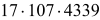
The following table summarizes some of the known Thābit ibn Qurra rules  (Borho
1972, te Riele 1974).
(Borho
1972, te Riele 1974).
 |  |  |  |
 |  | 72 | 127 |
 |  | 108 | 193 |
 |  | 240 | 449 |
 |  | 252 | 457 |
 |  | 1164 | 2129 |
 |  | 2700 | 5281 |
 |  | 5868 | 10753 |
 |  | 7104 | 13313 |
 |  | 7308 | 14081 |
 |  | 7308 | 14401 |
 |  | 17100 | 33601 |
 |  | 31752 | 57457 |
 |  | 67500 | 134401 |
 |  | 67500 | 134401 |
 |  | 162288 | 311041 |
 |  | 477900 | 950401 |
 |  | 1512300 | 3021761 |
 |  | 6750828 | 13478401 |
 |  | 8436960 | 16329601 |
 |  | 8520192 | 17007103 |
 |  | 18366768 | 36514801 |
 |  | 1199936448 | 2399587741 |

 ." Math. Comput. 23, 869-875, 1969.Riesel,
H.
." Math. Comput. 23, 869-875, 1969.Riesel,
H.