


The tetranacci numbers are a generalization of the Fibonacci numbers defined by  ,
,  ,
,  ,
,  , and the recurrence
relation
, and the recurrence
relation
 |
(1)
|
for integers  . They represent the
  case of the Fibonacci
n-step numbers. The first few terms for
case of the Fibonacci
n-step numbers. The first few terms for  , 1, ... are 0, 1, 1, 2, 4, 8, 15, 29, 56, 108, 208, ...
(OEIS A000078, whose term at index
, 1, ... are 0, 1, 1, 2, 4, 8, 15, 29, 56, 108, 208, ...
(OEIS A000078, whose term at index  is
is  ).
).
The first few prime tetranacci numbers have indices 3, 7, 11, 12, 36, 56, 401, 2707, 8417, 14096, 31561, 50696, 53192, 155182, ... (OEIS
A104534), corresponding to 2, 29, 401, 773,
5350220959, ... (OEIS A104535), with no others
for  (E. W. Weisstein, Mar. 21, 2009).
An exact expression for the  th tetranacci number for integers
  can be given explicitly by
 |
(2)
|
where the three additional terms are obtained by cyclically permuting  ,
which are the four roots of the polynomial
,
which are the four roots of the polynomial
 |
(3)
|
Alternately,
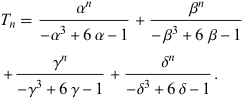 |
(4)
|
This can be written in slightly more concise form as
 |
(5)
|
where  ,
,
 ,
,
 ,
and
,
and  .
These coefficients are the four roots
of the polynomial
.
These coefficients are the four roots
of the polynomial
 |
(6)
|
The tetranacci numbers have the generating function 
 |
(7)
|
for  ,
where
,
where  is the tetranacci constant.
The ratio  tends to the positive real
root of
tends to the positive real
root of  ,
namely 1.92756... (OEIS A086088), which is
sometimes known as the tetranacci constant.
,
namely 1.92756... (OEIS A086088), which is
sometimes known as the tetranacci constant.
