

In category theory, a tensor category in the broad sense, also called a monoidal category,  consists of a category
  , an object
  of
of  , a functor
  , and a natural
isomorphism
, and a natural
isomorphism
 |  |  |
(1)
|
 |  |  |
(2)
|
 |  |  |
(3)
|
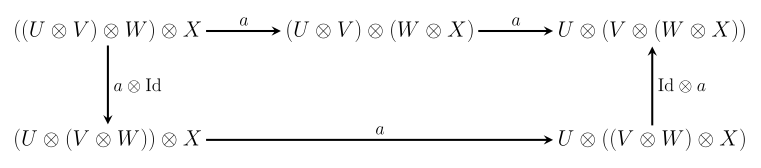
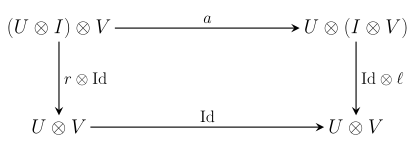
where the data are subject to the following axioms:
1. Given four objects  ,
,  ,
,  , and
, and  of
of  , the top diagram above commutes.
2. Given two objects  and
and  of
of  , the bottom diagram above commutes.
In the above,  is called the tensor product,
  is called the associator,
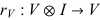
  is called the right unit, and
  is called the left unit of the tensor category. The object
  is referred to as the neutral element
or the identity of the tensor product.
is referred to as the neutral element
or the identity of the tensor product.
If the maps  ,
,
 , and
, and  are always identities, the tensor category in question is
said to be strict.
are always identities, the tensor category in question is
said to be strict.
In some contexts in representation theory, "tensor category" is reserved for a linear monoidal category with additional rigidity or the requirement that it be an Abelian category.
Johnson-Freyd et al. (2026) asked whether a semisimple category equipped with a tensor product and associativity
isomorphisms for which the pentagon commutes only
up to a scalar on simple objects
is necessarily  -quasi-monoidal
for some group
-quasi-monoidal
for some group  , meaning that the scalar depends
only on the
, meaning that the scalar depends
only on the  -degrees
of the four objects. Etingof et al. (2026) defined
categorical
-degrees
of the four objects. Etingof et al. (2026) defined
categorical  -cocycles for
  , 3, and 4 and proved that each is pulled back from a group
  -cocycle on the universal grading
group of the underlying based ring.
The case
-cocycle on the universal grading
group of the underlying based ring.
The case  answers the question affirmatively.
Etingof et al. (2026) report collaborating with ChatGPT 5.5 Pro, especially on the appendix containing this result. As of Sep. 30, 2026, independent review had not been reported.
A related notion is that of a tensor R-category.
