

The Taylor polynomial of order  for a function
  about
about  is the polynomial
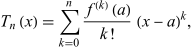 |
where  is a nonnegative integer and the derivatives through
order
is a nonnegative integer and the derivatives through
order  exist at
  .
Its polynomial degree is at most
.
Its polynomial degree is at most  . It agrees with
  and its first
  derivatives at
  .
.
When  has a Taylor series about
  , its Taylor polynomial of order
  consists of the first
  terms. Unlike the infinite Taylor
series, this polynomial requires only the first
terms. Unlike the infinite Taylor
series, this polynomial requires only the first  derivatives at
  and does not require convergence
of the series to
and does not require convergence
of the series to  .
The difference
.
The difference  is the Taylor remainder. For example, the Taylor
polynomial of order 2 for
is the Taylor remainder. For example, the Taylor
polynomial of order 2 for  about 0 is
  .
.
