

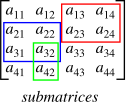
A submatrix of a matrix is obtained by selecting a subset of its rows and a subset of its columns, retaining their original order. The selected rows and columns need not be consecutive. Equivalently, a submatrix is obtained by deleting any collection of rows and columns (Horn and Johnson 2013, p. 17).
For an  matrix
  , let
, let  and
and  be subsets of
  and
and  , respectively, with their elements in increasing order.
The corresponding
, respectively, with their elements in increasing order.
The corresponding  submatrix is denoted
![A[I,J]=(a_(i_rj_s)),](/images/equations/Submatrix/NumberedEquation1.svg) |
(1)
|
where  and
and  . For example, given
![A=[1 2 3 4; 5 6 7 8; 9 10 11 12],](/images/equations/Submatrix/NumberedEquation2.svg) |
(2)
|
selecting rows 1 and 3 and columns 2 and 4 gives
![A[{1,3},{2,4}]=[2 4; 10 12].](/images/equations/Submatrix/NumberedEquation3.svg) |
(3)
|
This submatrix is not a contiguous rectangular block of the original matrix. A block formed from consecutive rows and columns is a special case of a submatrix, as used in a block matrix.
For a square matrix, selecting the same index set for both rows and columns gives a principal submatrix ![A[I,I]](/images/equations/Submatrix/Inline10.svg) . The determinant
of a square submatrix is a minor.
. The determinant
of a square submatrix is a minor.
