

A structure homomorphism from a structure  to a structure
  for a common language
  is a function that preserves
the interpretations of the constants, relations,
and functions in
is a function that preserves
the interpretations of the constants, relations,
and functions in  . In logic, this use of the term
"homomorphism" is similar to but somewhat
different from its use in abstract algebra. It
is a special case of a "morphism" from category theory.
. In logic, this use of the term
"homomorphism" is similar to but somewhat
different from its use in abstract algebra. It
is a special case of a "morphism" from category theory.
Let  ,
and
,
and  be structures for a common language
  , and let
  . Then
  is a homomorphism from
  to
to  provided that it satisfies the following:
1. For each constant  ,
,  .
.
2. For each predicate symbol  of arity
  , whenever
 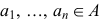 , one has
  .
.
3. For each function symbol (or operation)  , if the arity of
  is
is  , then for any
  ,
,
 |
For example, let  and
and  be directed graphs,
where
be directed graphs,
where  and
and  are their sets of vertices, and
  and
and  are their sets of directed edges.
A homomorphism from
are their sets of directed edges.
A homomorphism from  to
to  is a function
  such that whenever
  , one has
  .
.
Another example is available in the theory of ordered groups. Let  and
and  be ordered groups. (We are using
the symbol
be ordered groups. (We are using
the symbol  to denote the multiplicative inversion operation. We will drop the superscripts
  and
and  ,
and for any
,
and for any  (or
(or  ),
we denote
),
we denote  by
by  .)
Formal application of our definition of a homomorphism in this setting indicates
that
.)
Formal application of our definition of a homomorphism in this setting indicates
that  is a homomorphism iff it satisfies the following:
1.  .
.
2. For  ,
,
 .
.
3. For any  ,
,
 .
.
4. For any  ,
if
,
if  ,
then
,
then  .
.
The first and third conditions follow from the second for groups, so group homomorphisms are often defined only by preservation of multiplication. The fourth condition records preservation of the order relation.
The homomorphisms of universal algebra are special cases of structure homomorphisms, and the notion of a structure homomorphism also extends the corresponding morphism notions in categories of ordered sets and various relational/algebraic structures.
