

A stationary distribution of a Markov chain with transition matrix  is a vector of probabilities
 satisfying
 |
If the initial state has statistical distribution  , then every later state has the same statistical
distribution. Thus
 is a left eigenvector
of
 with eigenvalue 1, normalized to have nonnegative
entries with sum 1.
For a Markov chain on a general state space, a probability measure  is stationary when
 for every measurable
set
 , where
 is the transition probability
from
 into
 . The Bak-Sneppen model
provides an example on the continuous state space
 (Alberts et al. 2017).
A finite Markov chain in which every state is reachable from every other has a unique stationary distribution with all entries positive. Convergence to it from every initial statistical distribution additionally requires that the greatest common divisor of the possible state-return times be 1.
For a time-homogeneous continuous-time Markov process on a finite state space,
let  for
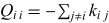 and
 , where
 is the transition rate from state
 to state
 .
The stationary-distribution equation becomes
 |
The detailed balance conditions are sufficient for either stationary-distribution equation, but are not necessary.
