


The standard deviation distribution is the statistical distribution of the sample standard deviation
 |
(1)
|
for  independent observations taken from a population with a normal
distribution, where
 is an integer and
 is the sample mean. The probability density function of
 is zero for
 and, for
 , is given by
 |
(2)
|
where  is a gamma function and
 is the fixed population variance,
 |
(3)
|
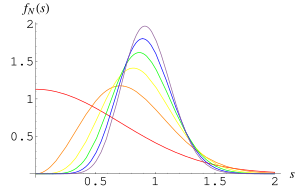
(Kenney and Keeping 1951, pp. 161 and 171). The function  is plotted above for
 (red), 4 (orange), ..., 10 (blue), and 12 (violet).
The mean is given by
 |  |  |
(4)
|
 |  |  |
(5)
|
where
 |
(6)
|
(Kenney and Keeping 1951, p. 171). In the usual statistical process control convention,  , where
 is the bias factor for the sample standard
deviation with denominator
 (Duncan 1986, pp. 62 and 134; National Institute of
Standards and Technology). Romanovsky (1925) gave the asymptotic
expansion, as
 ,
 |
(7)
|
(OEIS A088801 and A088802, Romanovsky 1925, Pearson 1935; Kenney and Keeping 1951, p. 171).
For real  , the raw moments are
given by
 |
(8)
|
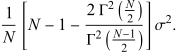
and the variance of  is
 |  |  |
(9)
|
 |  |  |
(10)
|
 is an unbiased estimator of
 (Kenney and Keeping 1951, p. 171).
