TOPICS
Search

Squeeze Theorem


SqueezingTheorem

The squeeze theorem, also known as the squeezing theorem, pinching theorem, or sandwich theorem, states that if f_-(x)<=f(x)<=f_+(x) on a common domain sufficiently close to its accumulation point a, excluding a itself, and

 lim_(x->a)f_-(x)=lim_(x->a)f_+(x)=r,

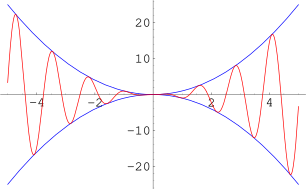
then lim_(x->a)f(x)=r. In the above diagram the functions f_-(x)=-x^2 and f_+(x)=x^2 bound x^2sin(cx) from below and above, so lim_(x->0)x^2sin(cx)=0.

For sequences, if a_n<=b_n<=c_n for all sufficiently large n and

 lim_(n->infty)a_n=lim_(n->infty)c_n=L,

then lim_(n->infty)b_n=L. For any epsilon>0, both bounding sequences eventually lie between L-epsilon and L+epsilon, so the middle sequence does as well.


See also

Limit, Sequence

Explore with Wolfram|Alpha

Cite this as:

Weisstein, Eric W. "Squeeze Theorem." From MathWorld--A Wolfram Resource. https://mathworld.wolfram.com/SqueezeTheorem.html

Subject classifications

