

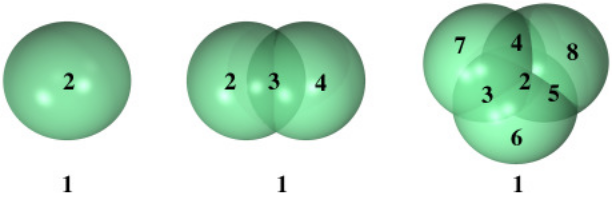
The maximal number of regions into which three-dimensional space can be divided by  spheres, for
 , is
 |
giving 2, 4, 8, 16, 30, 52, 84, ... (OEIS A046127) for  ,
2, ... (Yaglom and Yaglom 1987, pp. 105-106).
The maximum is attained when every pair of spheres intersects in a circle, every triple intersects in two points, and no four have a common point. With no spheres, there is one region.
More generally, for  and
 , the maximal number of regions determined by
 hyperspheres in
 -dimensional Euclidean space
is
 |
In particular,  for
 (F. M. Jackson, pers. comm., Feb. 24, 2006). The upper bound follows
by counting the regions cut on each successive hypersphere.
An arrangement attaining it is obtained by stereographic
projection of
 great hyperspheres in general
position on the unit hypersphere in
 -dimensional Euclidean space.
