


Somos's quadratic recurrence constant is  , where the sequence
 is defined by
 |
(1)
|
for integers  , with
 . This has closed-form solution
 |
(2)
|
where  is a polylogarithm
and
 is a Lerch transcendent. For
 , 1, ..., the first few terms are 1, 1, 2, 12, 576, 1658880,
16511297126400, ... (OEIS A052129). As
 ,
the terms of this sequence have asymptotic
growth given by
 |
(3)
|
(OEIS A116603; Finch 2003, p. 446,  term corrected). The formal generating function
 of these asymptotic coefficients
satisfies the functional equation
 |
(4)
|
Expressions for  include
 |  |  |
(5)
|
 |  |  |
(6)
|
 |  |  |
(7)
|
 |  |  |
(8)
|
 |  |  |
(9)
|
(OEIS A112302; Ramanujan 2000, p. 348; Finch 2003, p. 446; Guillera and Sondow 2008).
Expressions for  include
 |  |  |
(10)
|
 |  |  |
(11)
|
 |  |  |
(12)
|
 |  |  |
(13)
|
 |  |  |
(14)
|
(OEIS A114124; Finch 2003, p. 446; J. Borwein, pers. comm., Feb. 6, 2005; Guillera and Sondow 2008), where  is a polylogarithm.
 is also given by the unit square integral
 |  |  |
(15)
|
 |  | 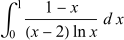 |
(16)
|
(Guillera and Sondow 2008).
Ramanujan (1911; 2000, p. 323) proposed finding the nested radical expression
 |
(17)
|
which converges to 3. Vijayaraghavan (in Ramanujan 2000, p. 348) gives the justification of his process both in general, and in the particular example of  .
