

The Smith normal form of an  matrix
  over a principal ideal
domain
over a principal ideal
domain  is an
is an  matrix
  satisfying
 |
(1)
|
where  and
and  are
are  and
and  matrices over
  whose inverses also have
entries in
whose inverses also have
entries in  ,
all entries of
,
all entries of  off the main diagonal are zero, and its nonzero diagonal
entries
off the main diagonal are zero, and its nonzero diagonal
entries  ,
...,
,
...,  satisfy
  .
Here
.
Here  means that
  divides
  in
in  . Any remaining diagonal entries
are zero, and
. Any remaining diagonal entries
are zero, and  is the rank of
  . The entries
  are the invariant factors,
determined uniquely up to multiplication by units of
are the invariant factors,
determined uniquely up to multiplication by units of  . This form exists over every principal
ideal domain, but not over every integral domain
(Stanley 2016).
. This form exists over every principal
ideal domain, but not over every integral domain
(Stanley 2016).
For an integer matrix,  and
and  are integer unimodular
matrices, so their determinants are
are integer unimodular
matrices, so their determinants are  . Requiring the nonzero diagonal
entries of
. Requiring the nonzero diagonal
entries of  to be positive makes the Smith normal form unique. For
example,
to be positive makes the Smith normal form unique. For
example,
![[1 0; 3 -1][2 4; 6 8][1 -2; 0 1]=[2 0; 0 4].](/images/equations/SmithNormalForm/NumberedEquation2.svg) |
(2)
|
The outer factors have determinants  and 1, respectively, and
  , so the Smith normal form of the middle matrix
has diagonal entries 2 and 4. This reduction is useful
for solving linear Diophantine equations.
, so the Smith normal form of the middle matrix
has diagonal entries 2 and 4. This reduction is useful
for solving linear Diophantine equations.
For the polynomial case, let  be an
be an  matrix over a field
  . Using elementary
row and column operations over the polynomial
ring
. Using elementary
row and column operations over the polynomial
ring ![F[x]](/images/equations/SmithNormalForm/Inline33.svg) ,
the
,
the  matrix
  (where
  is the identity matrix)
can be put into the diagonal matrix form
is the identity matrix)
can be put into the diagonal matrix form
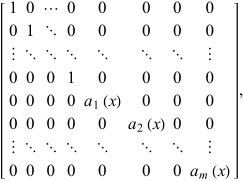
![[1 0 ... 0 0 0 0 0; 0 1 ... 0 0 0 0 0; | ... ... ... ... ... ... |; 0 0 0 1 0 0 0 0; 0 0 0 0 a_1(x) 0 0 0; 0 0 0 0 0 a_2(x) 0 0; | ... ... ... ... ... ... |; 0 0 0 0 0 0 0 a_m(x)],](/images/equations/SmithNormalForm/NumberedEquation3.svg) |
(3)
|
where  ,
,
 , ...,
  are monic polynomials
in
are monic polynomials
in ![F[x]](/images/equations/SmithNormalForm/Inline40.svg) with degrees at least one and satisfying
with degrees at least one and satisfying  , where
  means
means  divides
  , which in turn divides
  , and so on (Dummit and Foote 2004, p. 479). The allowed
operations interchange rows or columns, add a polynomial
multiple of one to another, or multiply a row or column by a unit
of
, and so on (Dummit and Foote 2004, p. 479). The allowed
operations interchange rows or columns, add a polynomial
multiple of one to another, or multiply a row or column by a unit
of ![F[x]](/images/equations/SmithNormalForm/Inline46.svg) ,
namely a nonzero constant in
,
namely a nonzero constant in  . The polynomials
  are the invariant factors
of
are the invariant factors
of  and determine its rational canonical form.
The Smith normal form of an integer matrix is implemented in the Wolfram Language as SmithReduce[A].
The full decomposition is given by SmithDecomposition[A],
which returns  satisfying
  .
For matrices of univariate polynomials,
PolynomialSmithDecomposition[M,
x] gives the corresponding decomposition over a polynomial
ring.
.
For matrices of univariate polynomials,
PolynomialSmithDecomposition[M,
x] gives the corresponding decomposition over a polynomial
ring.

 Pascoletti, A. "Smith
Normal Forms."
Pascoletti, A. "Smith
Normal Forms."